The phone rings. It’s Grandma, calling from Ibadan. She asks your daughter something in Yoruba, warm and quick, the way only a grandmother can. Your daughter smiles, looks at you for help, and says, “Hi, Grandma.”
If that moment feels familiar, you’re in good company. Many Yoruba families in London, Houston, Toronto and beyond are raising children who understand a little Yoruba and speak even less. And plenty of adults grew up hearing it at home every day, yet never quite found their own voice in it.
Here’s the good news: it’s never too late, and it has never been easier to start. In this guide we’ll answer the question everyone asks first (does Duolingo have Yoruba?), share our honest picks for the best apps to learn Yoruba, explain tones without the headache, teach you the greetings that matter most, and pass on what really works when you’re teaching children far from home.
Let’s begin the Yoruba way, with a welcome: Ẹ káàbọ̀.
Why learn Yoruba? It’s bigger than you think
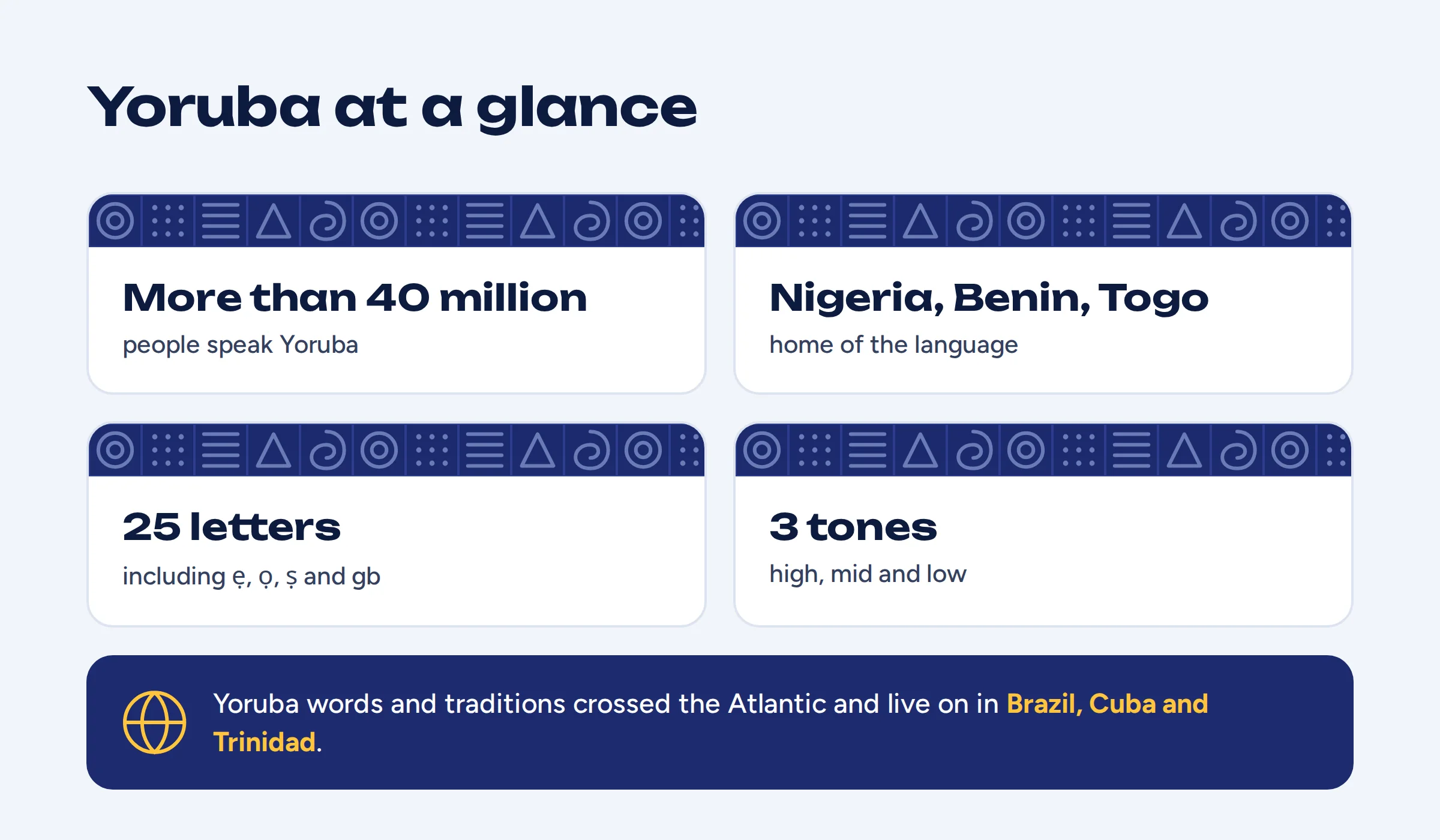
Yoruba is one of Africa’s great languages. It is spoken by more than 40 million people, mostly in south-western Nigeria (think Lagos, Ibadan, Abẹ́òkúta and Ọ̀yọ́), and also in Benin and Togo. Millions more speak it in the diaspora, from Peckham to Atlanta.
Its reach goes further still. Centuries ago, Yoruba words, songs and spiritual traditions crossed the Atlantic, and you can still hear them today in Brazil, Cuba and Trinidad. Turn on Afrobeats and you’ll catch Yoruba lines in many of the biggest songs. Watch a Nollywood film and you may find it’s entirely in Yoruba.
For many of our learners, though, the reason is closer to home. It’s being able to follow the jokes at a family party. It’s understanding your own name. Yoruba names carry whole sentences of meaning: Adé means “crown”, and Olúwaṣeun is roughly “thank you, God”. It’s wanting your children to feel that their heritage belongs to them, not just to their grandparents.
Whatever your reason, it’s a good one. Now let’s clear up the question that brings most people to this page.
Does Duolingo have Yoruba?
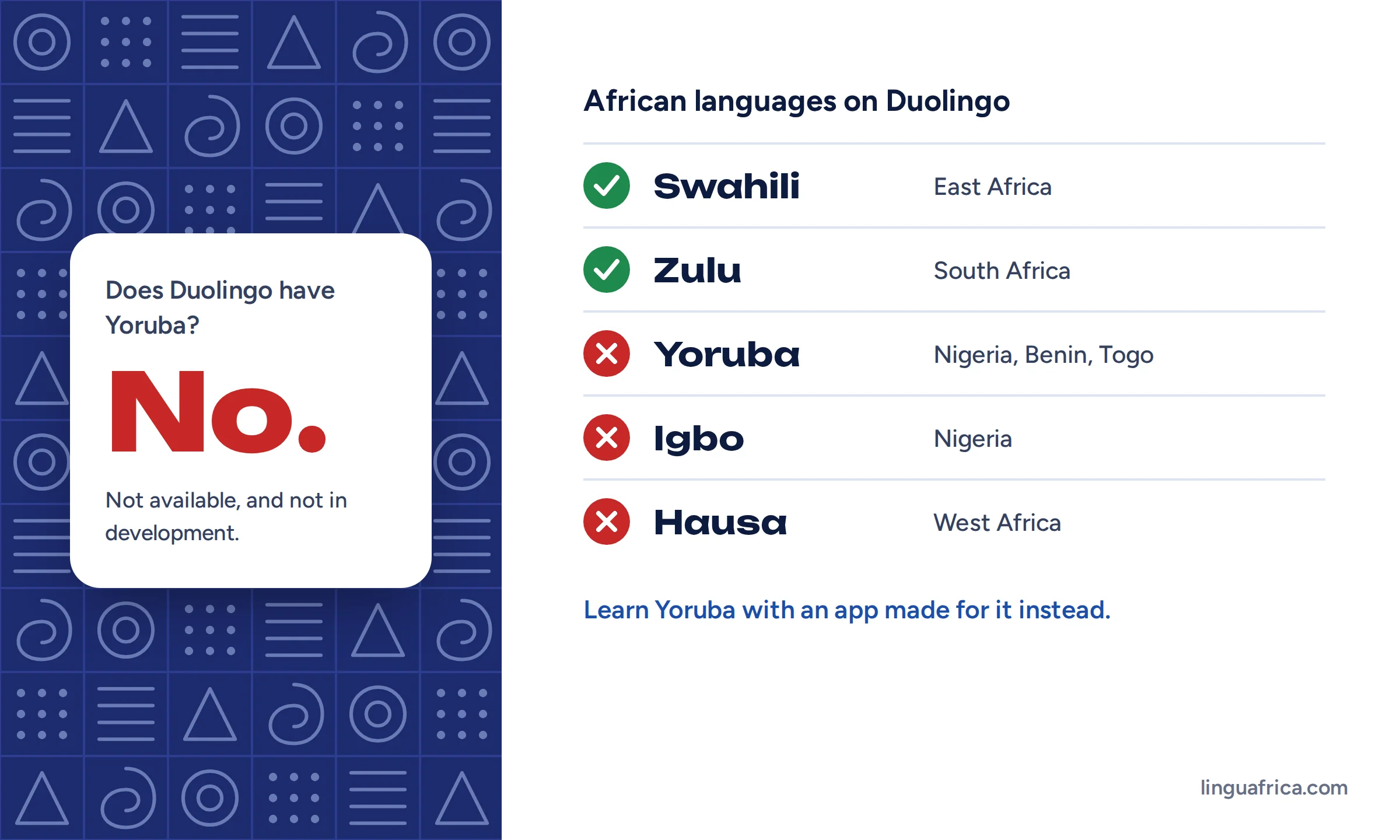
The short answer: no. As of 2026, Duolingo does not offer a Yoruba course, and there is no Yoruba course in development. So if you opened the app and searched for it, it wasn’t you. It simply isn’t there.
Duolingo currently teaches two African languages, Swahili and Zulu. A Xhosa course was added for a while and then removed in 2023. No West African language (not Yoruba, Igbo, Hausa or Twi) has ever been on the platform.
Why not? Duolingo hasn’t said much publicly. One likely reason is that Yoruba is a tonal language: the same letters can mean completely different things depending on the pitch of your voice. Teaching that well needs audio-first lessons and tools built around tone, and that takes specialist work.
What about Google Translate? It does include Yoruba, and it’s handy for checking a single word. But a translation tool can’t teach you how a word sounds, which tone to use, or when to add a respectful Ẹ for an elder. For that, you need lessons built for learners.
The good news is that you don’t need Duolingo. Yoruba now has several good apps of its own, plus free resources and real teachers online. Here’s how they compare.
The best apps to learn Yoruba for beginners
Before we start, a quick and honest note: we make one of these apps, so we’re not neutral. We’ve tried to be fair to everyone, and here is the truth we tell every learner: the best results usually come from combining two or three tools, not from finding one perfect app.
Linguafrica. This is ours. It teaches Yoruba (as well as Swahili and Zulu) in bite-sized lessons with audio, visuals, storytelling and cultural notes, with progress tracking and streaks to keep you coming back. It was designed for children first, which also makes it friendly for adult beginners who want a gentle start. It’s available on Android and iPhone.
Nkenne. A dedicated African-language app that teaches nine languages, including Yoruba, Igbo and Swahili. It mixes flashcards and lessons with game-style rewards, and it also has a blog and podcast about African culture.
Ling. A general language app with a full Yoruba course. A useful extra is an AI chatbot you can practise short conversations with. It works on a paid subscription.
Drops. Best for building vocabulary. Drops added Yoruba in 2021, and its five-minute, picture-based sessions are a fun way to learn everyday words. It focuses on words rather than grammar or conversation, so treat it as a side dish rather than the main meal.
YouTube and podcasts (free). Listening is the secret weapon for a tonal language. Yoruba songs, films, cooking videos and children’s channels all train your ear. Our own Linguafrica YouTube channel and podcast are good places to start.
A tutor. Nothing replaces a real person who can hear your tones and gently correct them. Sites like Preply and italki list Yoruba tutors, and many of them work specially with heritage learners and children.
How to choose a Yoruba app
Whichever app you try, look for these five things:
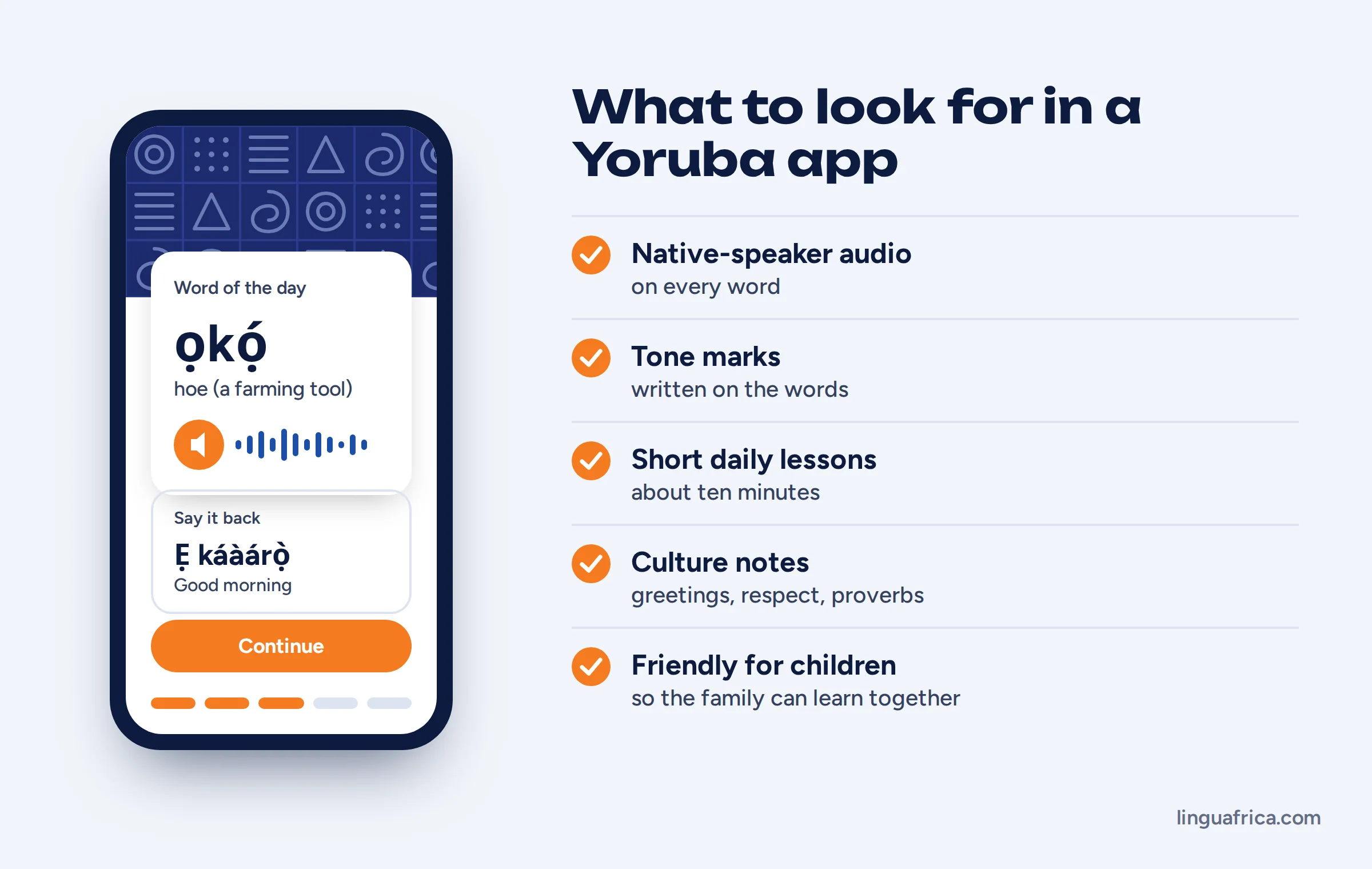
- Native-speaker audio on every word. You can’t learn tones from text alone.
- Tone marks written on the words. Apps that drop the accents make reading harder later.
- Short daily lessons. Ten minutes every day beats an hour once a week.
- Culture, not just vocabulary. Greetings, respect and proverbs are part of the language.
- Friendly for children, if you’re learning as a family.
A simple routine that works for most beginners: one app for ten minutes a day, Yoruba music or video while you cook or commute, and one conversation a week with a tutor or a relative.
How to learn Yoruba as an adult: start with sounds and tones
Learning as an adult has real advantages. You can spot patterns, you know why you’re doing it, and if you grew up around Yoruba, your ears probably know more than you think. Many heritage learners are surprised how quickly the language comes back once they start speaking.
The best place to begin is with how Yoruba sounds.
The Yoruba alphabet
The Yoruba alphabet has 25 letters. It uses no c, q, v, x or z, and it adds a few letters you won’t find in English.
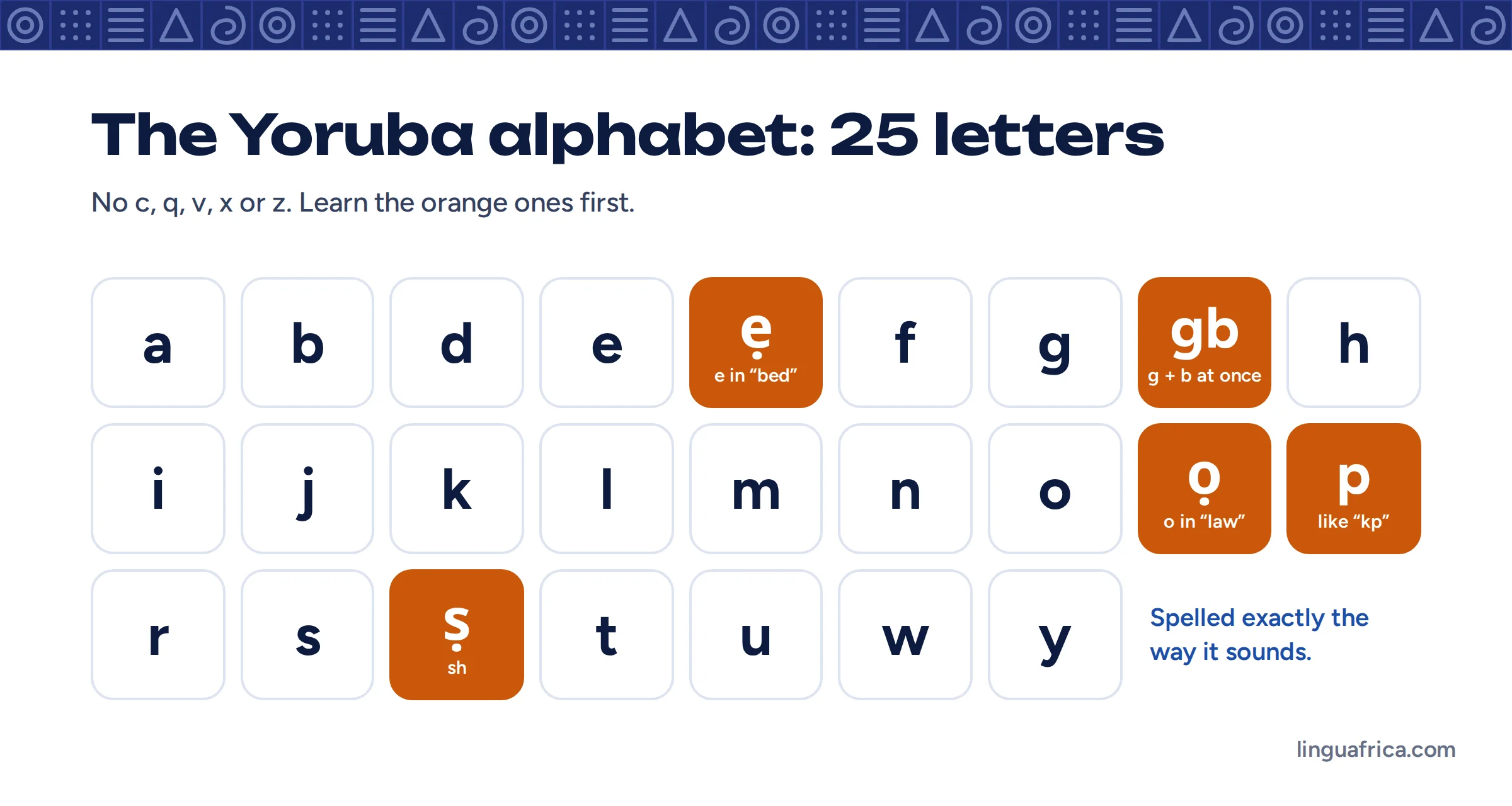
The special ones to learn first:
- ẹ sounds like the e in “bed”.
- ọ sounds like the o in “for” or “law”.
- ṣ sounds like sh, as in “shoe”.
- gb is a single sound: say g and b at the same moment. It’s tricky at first, and that’s normal.
- p is also special. Yoruba has no plain English p; it’s pronounced like kp pressed together, in one quick sound.
The good news is that Yoruba is spelled the way it sounds. Once you know these letters, you can read almost anything aloud.
The three tones (the part everyone worries about)
Yoruba has three tones: high, mid and low. A tone is simply the pitch of your voice on a syllable. Written Yoruba marks them with accents: an acute accent (´) for high, a grave accent (`) for low, and usually no mark for mid.
Tones matter because they change meaning. The classic example uses three words that look almost the same:
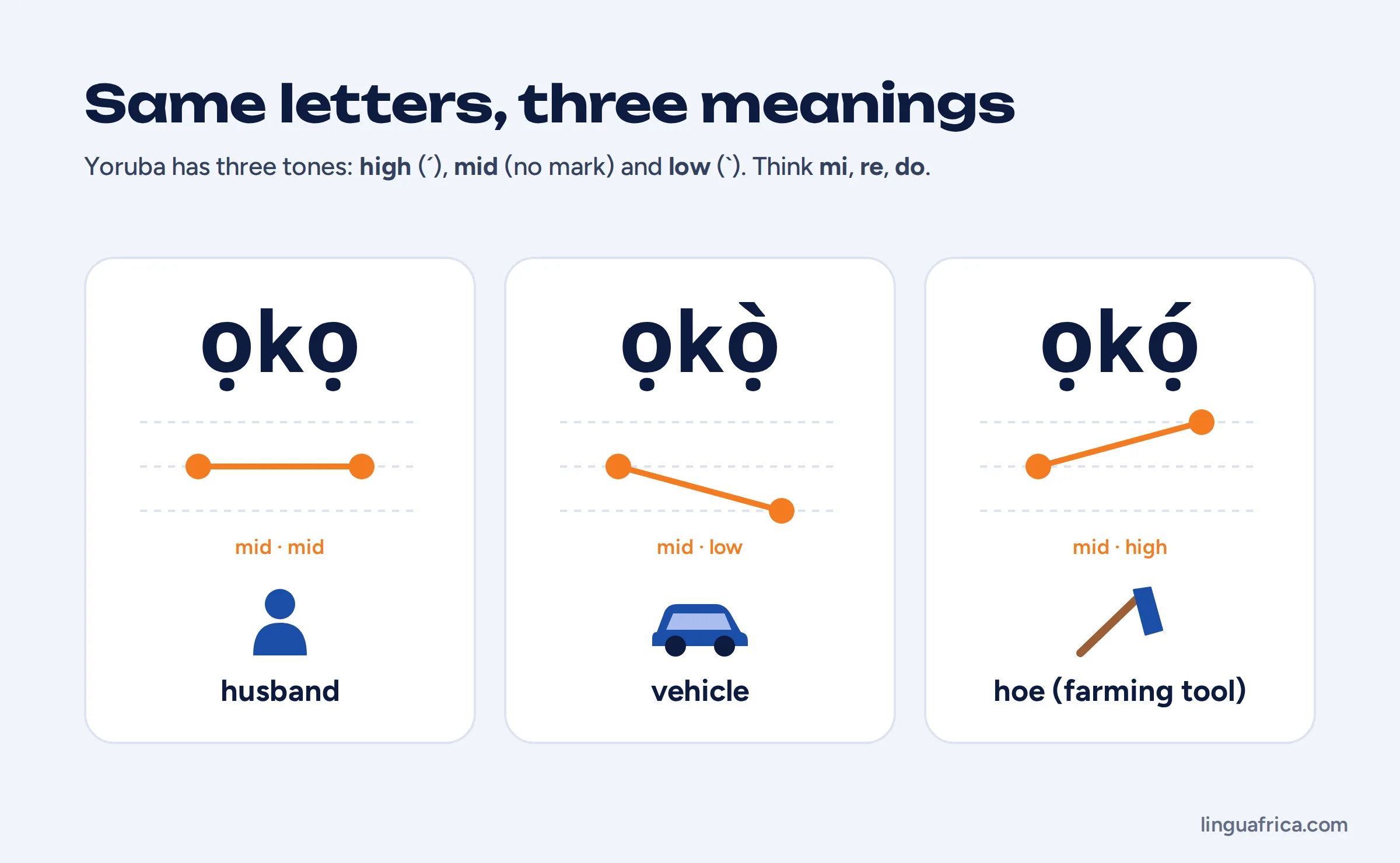
| Word | Tones | Meaning |
|---|---|---|
| ọkọ | mid, mid | husband |
| ọkọ̀ | mid, low | vehicle |
| ọkọ́ | mid, high | hoe (a farming tool) |
Many teachers compare the three tones to singing do-re-mi: low is do, mid is re, high is mi. Hum it, then say the words. It feels silly for about a day, then it starts to feel like music.
A few tips that make tones easier for adults:
- Listen before you read. Play a word, copy it out loud, and only then look at the spelling.
- Learn whole phrases, not single words. Tones flow more naturally in real sentences.
- Record yourself. Compare your voice with a native speaker’s. You’ll hear the difference quickly.
- Type with tone marks. Many phone keyboards, including Gboard, offer a Yoruba layout, which makes accents easy.
Your first month, week by week
It helps to know what “progress” looks like, so you don’t give up just before it gets good. Here’s a realistic first month with about ten minutes a day:
- Week 1: Sounds. Learn the special letters (ẹ, ọ, ṣ, gb and p) and play with the three tones. Say ọkọ, ọkọ̀ and ọkọ́ until you can hear the difference.
- Week 2: Greetings. Learn the time-of-day greetings below, plus Báwo ni? and Dáadáa ni. Greet someone in Yoruba every single day, even if it’s just your reflection.
- Week 3: You and your family. Learn to say your name (Orúkọ mi ni…, “My name is…”) and words like bàbá (father), màmá (mother) and ilé (home).
- Week 4: Your first real conversation. Call a relative or book a tutor and have a two-minute chat using everything you know. It will feel wobbly. That’s exactly how it should feel.
By the end of the month you won’t be fluent, but you’ll have something more useful: a habit, a handful of phrases you can use with confidence, and proof that you can do this.
Your first Yoruba greetings (and why respect matters)
If you learn only one thing about Yoruba culture, learn this: greetings matter. Yoruba has a greeting for almost every moment, including the time of day, someone’s work and even the weather, and greeting an elder properly says a great deal about how you were raised.
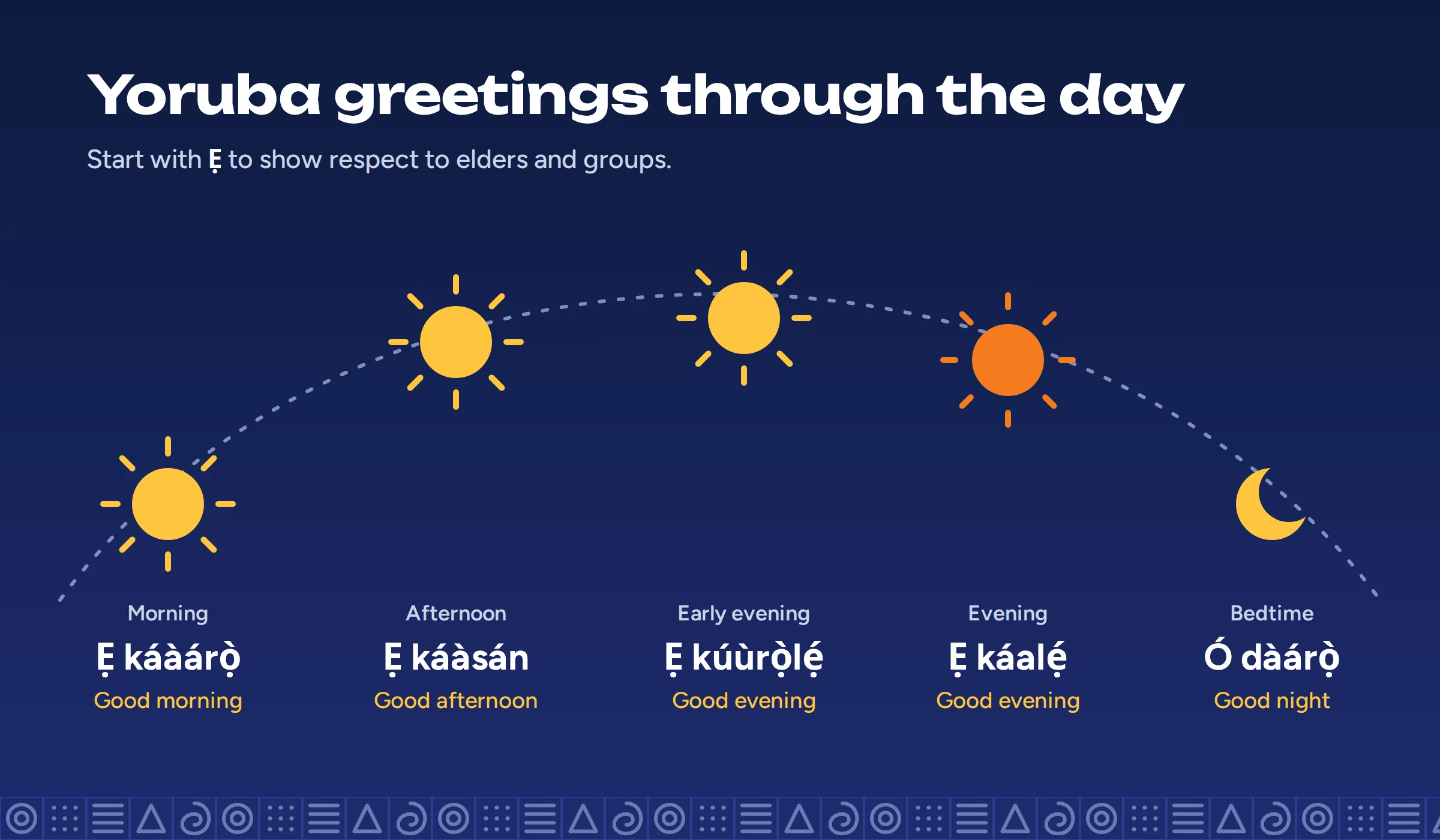
| When | Greeting | Meaning |
|---|---|---|
| Morning | Ẹ káàárọ̀ | Good morning |
| Afternoon | Ẹ káàsán | Good afternoon |
| Early evening | Ẹ kúùrọ̀lẹ́ | Good evening |
| Evening and night | Ẹ káalẹ́ | Good evening |
| Bedtime | Ó dàárọ̀ | Good night (until morning) |
Notice the Ẹ at the start. It’s a mark of respect, used with elders, strangers and groups. With friends and younger people, you can drop it and simply say Káàárọ̀.
A few more phrases you’ll use every day:
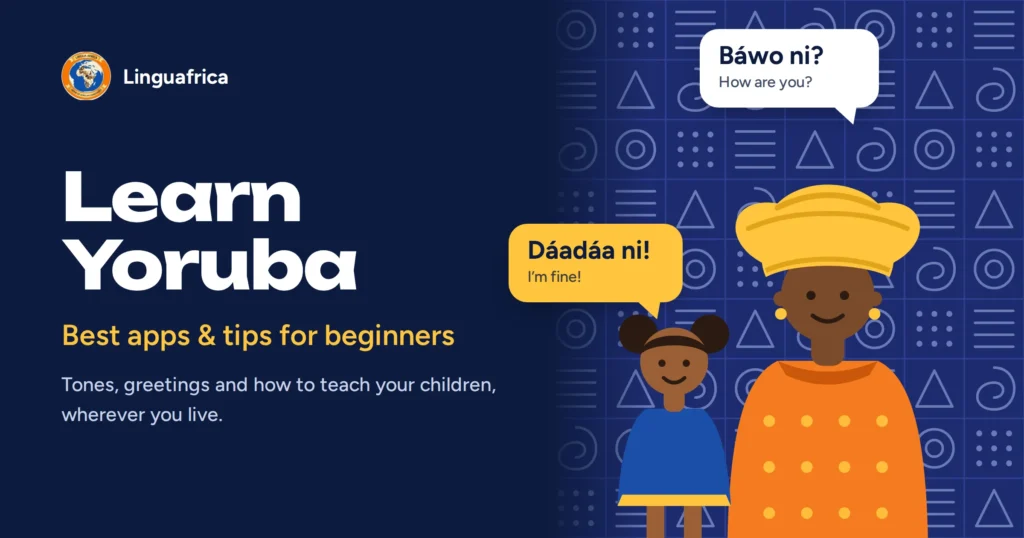
- Báwo ni? How are you? (or “How’s it going?”) The usual reply is Dáadáa ni, “It’s fine.”
- Ẹ ṣé means “thank you” (respectful). To a friend, say O ṣé.
- Ẹ kú iṣẹ́ is said to someone who is working, a bit like “well done” or “keep it up”.
- Ẹ káàbọ̀ means “welcome”.
Greeting with your body, too
Traditionally, Yoruba children greet their elders with their whole body: boys and men prostrate (dọ̀bálẹ̀) and girls and women kneel (kúnlẹ̀). In the diaspora, many families keep a softer version, a small bow or a quick bend of the knee. Either way, the message to a grandparent is the same: I respect you. Teaching children this simple gesture, together with Ẹ káàárọ̀, is one of the loveliest first steps you can take.
How to teach your child Yoruba abroad
Here’s something many parents only discover later: speaking Yoruba at home is not always enough on its own. Children spend most of their day in English, and they quickly learn that they can answer you in English and still be understood. Over time, Yoruba becomes a language they hear but don’t speak.
That’s not a failure. It’s just how languages work when one is everywhere and the other is only at home. The answer is to make Yoruba a small, warm, daily habit.
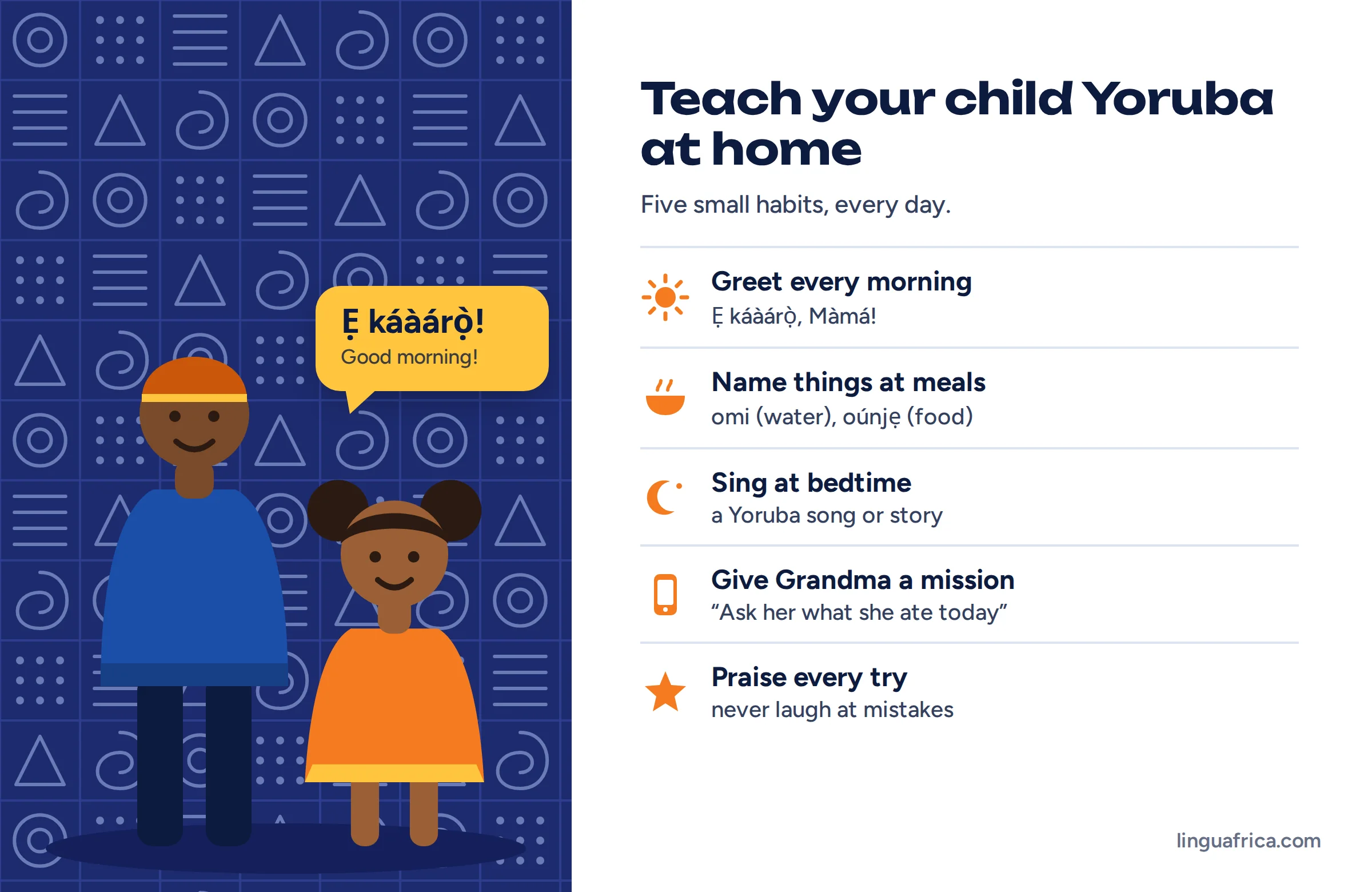
- Own the small moments. Greetings in the morning, words at mealtimes, a song at bedtime. Label things around the house: omi (water) on the jug, oúnjẹ (food) on the fridge. Five minutes of Yoruba every day beats an hour on Saturday.
- Answer in Yoruba, gently. When your child replies in English, repeat their answer back in Yoruba and invite them to try. No pressure, no lectures.
- Praise the try, never the perfect. Never laugh at mistakes. A child who feels embarrassed goes quiet; a child who feels proud tries again.
- Give Grandma a mission. Turn video calls into games: “Ask Grandma what she ate today, in Yoruba.” Grandparents love it, and children remember it.
- Sing and watch together. Yoruba songs, stories and children’s videos make the language feel fun rather than like homework.
- Find your people. Saturday schools, church or mosque groups and other Yoruba families help children see they’re not the only ones.
- Use a kid-friendly app. A few minutes a day with short, playful lessons keeps the habit going between family moments. That’s exactly what we built Linguafrica for.
If you’re learning alongside your child, even better. Children love catching their parents’ mistakes, and learning together turns practice into play. Our guide to learning Zulu as a beginner uses the same family-friendly approach, and our Languages page shows everything we teach.
Frequently asked questions
Does Duolingo have Yoruba?
No. As of 2026, Duolingo does not offer a Yoruba course and none is in development. Its two African courses are Swahili and Zulu. To learn Yoruba, use a dedicated app such as Linguafrica or Nkenne, a general app with a Yoruba course such as Ling or Drops, or a tutor.
What is the best app to learn Yoruba for beginners?
Look for an app with native-speaker audio, tone marks on every word, short daily lessons and cultural notes. Linguafrica is designed for beginners and children, Nkenne focuses on African languages, Ling adds conversation practice with an AI chatbot, and Drops is good for vocabulary. Most learners do best by combining one app with listening and a weekly conversation.
Is Yoruba hard to learn?
Some parts are easy: it uses the Latin alphabet and is spelled the way it sounds. The main challenge for English speakers is tone, because pitch changes meaning. With daily listening and practice, most people find tones become natural much faster than they feared.
How long does it take to learn Yoruba?
With about 10 to 15 minutes a day, most beginners can handle greetings and simple introductions within a few weeks, and basic everyday conversation within a few months. Heritage learners who grew up hearing Yoruba often progress even faster.
Can I learn Yoruba as an adult if I only understand a little?
Absolutely. Many adults who grew up hearing Yoruba understand far more than they can say. The key is to start speaking early, even with mistakes, and to practise with family whenever you can.
What does Báwo ni mean?
Báwo ni? is the everyday Yoruba way to ask “How are you?” or “How’s it going?”. The usual reply is Dáadáa ni (“It’s fine”). With an elder, start with a respectful time-of-day greeting such as Ẹ káàárọ̀ before asking.
How do I type Yoruba tone marks?
Add a Yoruba keyboard on your phone (Gboard offers one), then press and hold a letter to choose ẹ, ọ, ṣ or a letter with a tone mark. On a computer, you can install a Yoruba keyboard layout or use an online Yoruba keyboard tool.
Ẹ ṣé: thank you for starting
Learning Yoruba isn’t about being perfect. It’s about the first Ẹ káàárọ̀ that makes Grandma smile, the song your child sings in the car, and the day you understand the joke at the family party before anyone translates it.
Start small, keep it daily, and be kind to yourself along the way. When you’re ready to explore more, discover how greetings work in Swahili, read our guide on which African language to learn first, or find out why we started Linguafrica.