

Sawubona. It is the first word most people hear in isiZulu, and it is the perfect place to start. It is not just “hello”. It is usually translated as “I see you”, a greeting that tells the other person they matter.
Maybe you want to learn Zulu so you can talk with your grandmother in Durban, follow the conversation at a family wedding, or teach your children the language of their roots. Maybe you simply love the sound of it. Whatever your reason, this guide gives you a strong first step.
In the next few minutes you will learn what Sawubona really means and how to reply, the greetings you need for one person or a whole room, your first 20 Zulu words, how the famous click sounds work, and a simple 7-day plan to make it all stick. You do not need any experience. Read each section, say every word out loud, and come back to this page whenever you need it.
Why learn Zulu? isiZulu at a glance
In the language itself, Zulu is called isiZulu. The isi- at the start is a prefix used for the names of languages, so you will also see isiXhosa, isiNdebele and so on. The Zulu people call themselves amaZulu.
isiZulu is the most widely spoken home language in South Africa. In the 2022 census, 24.4% of South Africans said it was the language they speak most often at home. That is roughly 15 million people, or about one in every four South Africans. In the province of KwaZulu-Natal, around 80% of people speak it at home, and it is the biggest single home language in Gauteng, the province that includes Johannesburg. It is one of South Africa’s 12 official languages.
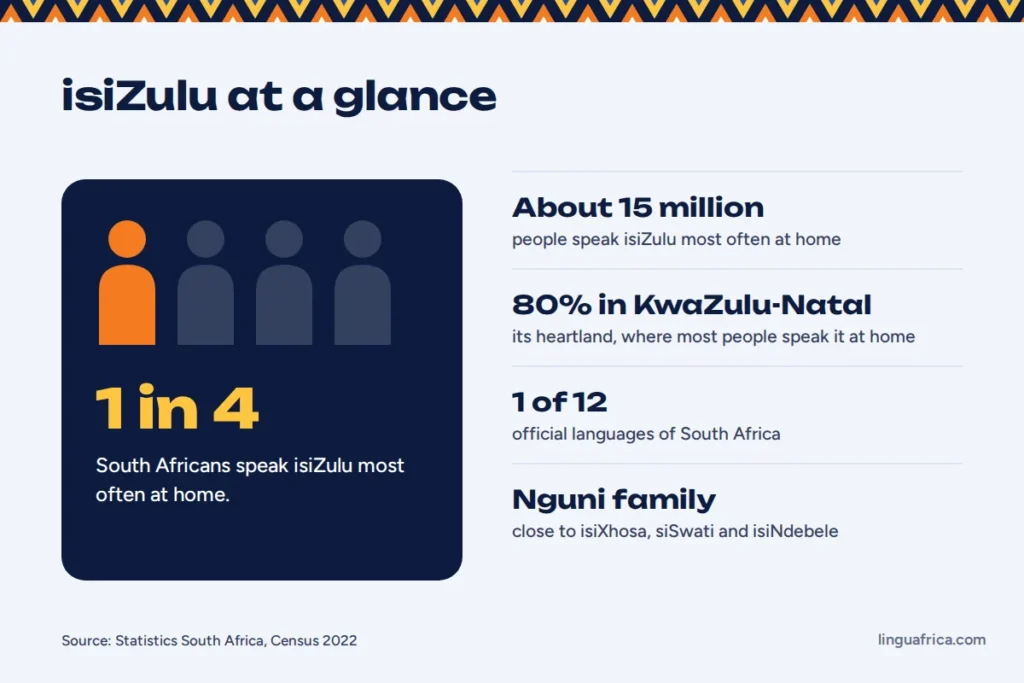
Zulu belongs to the Nguni group of Bantu languages. Its close relatives include isiXhosa, siSwati and isiNdebele. These languages share many words and patterns, so once you know some Zulu, you will often recognise words in the others too. You may already know a word or two from this family without realising it. Ubuntu, the idea that a person becomes a person through other people, comes from Nguni languages such as Zulu and Xhosa. In Zulu the full saying is Umuntu ngumuntu ngabantu.
So why learn it? Here are the reasons we hear most often from our learners:
- Family. Many people in the UK, the US and around the world have Zulu-speaking parents or grandparents. Even a few words change the way a visit home feels.
- Children. Kids pick up new sounds easily, including the clicks. Starting early gives them a link to their heritage that lasts a lifetime.
- Travel and work. Greeting someone in isiZulu in Durban or Johannesburg opens doors that English alone does not.
- Culture. Songs, praise poetry, proverbs and stories all make more sense when you understand the words behind them.
If you are still deciding which African language to begin with, our guide on which African language to learn first can help, and you can see every language we teach on our Languages page.
What does Sawubona mean in Zulu?
Sawubona (say sah-woo-BOH-nah) is the standard Zulu greeting for one person. You can use it at any time of day, morning, afternoon or evening, so you do not need separate words for “good morning” and “good afternoon” to get started.
It is usually translated as “I see you”. The word is built on the verb -bona, which means “to see”. The literal meaning is closer to “we see you”, and many speakers explain the “we” as the person greeting plus their family, or even their ancestors. Whichever way you explain it, the idea is the same: you are not just saying hello, you are recognising the other person. That is why Sawubona is often linked with ubuntu. A greeting is a small moment of respect.
How to respond to Sawubona
The usual reply is:
- Yebo, sawubona (YEH-boh, sah-woo-BOH-nah): “Yes, I see you too.”
- Or simply Yebo (“Yes”).
A greeting in Zulu rarely stops there. The next step is to ask how the other person is:
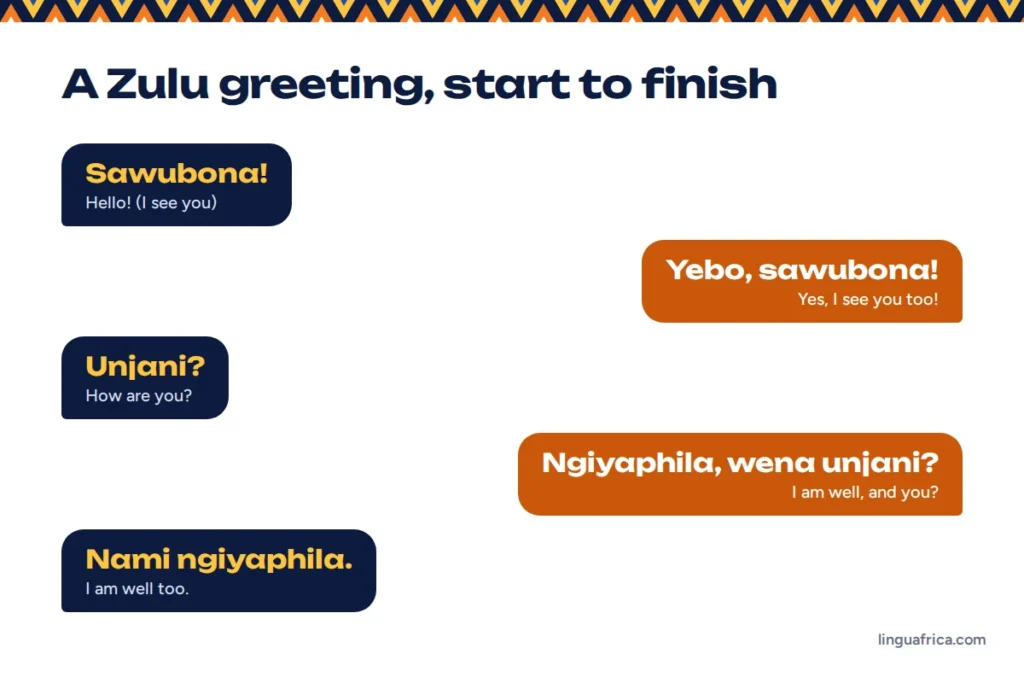
A short, complete conversation looks like this:
| Speaker | isiZulu | English |
|---|---|---|
| A | Sawubona! | Hello! (I see you) |
| B | Yebo, sawubona! | Yes, I see you too! |
| A | Unjani? | How are you? |
| B | Ngiyaphila, wena unjani? | I am well, and you? |
| A | Nami ngiyaphila. | I am well too. |
You will also hear Ngikhona as a reply to “How are you?”. It literally means “I am here”, and it is a friendly, everyday way of saying “I’m fine”.
Greeting with respect
In Zulu culture, the greeting matters. It is polite to greet before you ask anything, even a quick question in a shop. Younger people usually greet older people first. To show extra respect, add a title after Sawubona:
- Sawubona, baba to a man (literally “father”)
- Sawubona, mama to a woman (“mother”)
- Sawubona, gogo to a grandmother
Notice that ubaba (father) becomes baba when you speak directly to someone. In Zulu, when you call or address a person, the first vowel of the noun drops: umama becomes mama, ugogo becomes gogo. Many speakers also use the plural greeting, Sanibonani, with a respected elder, even when greeting just one person.
Zulu greetings and responses: one person or many
Zulu changes the greeting depending on how many people you are talking to. This is one of the first grammar points you will meet, and it is easier than it looks. Look for ni: the u that means “you” (one person) becomes ni for two or more, and goodbyes such as hamba kahle add -ni to the verb.
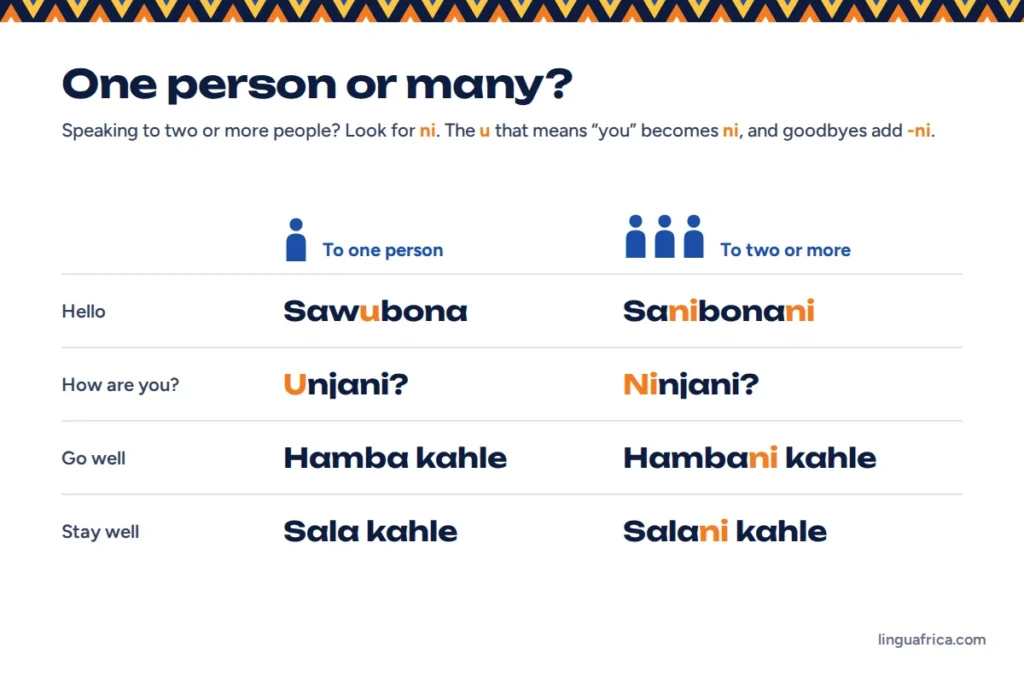
| English | To one person | To two or more people |
|---|---|---|
| Hello | Sawubona | Sanibonani |
| How are you? | Unjani? | Ninjani? |
| I am well / We are well | Ngiyaphila | Siyaphila |
| Go well | Hamba kahle | Hambani kahle |
| Stay well | Sala kahle | Salani kahle |
| Sleep well / Good night | Lala kahle | Lalani kahle |
The word kahle means “well” or “nicely”, and you will hear it all the time.
Hamba kahle or sala kahle?
This pair confuses almost every beginner, so it is worth a moment. Zulu goodbyes depend on who is leaving:
- If you are leaving, say Sala kahle: “Stay well” to the people who are staying.
- If the other person is leaving, say Hamba kahle: “Go well” to the person who is going.
A simple way to remember it: hamba means “go”, so you say it to the one who is going.
Your first 20 Zulu words
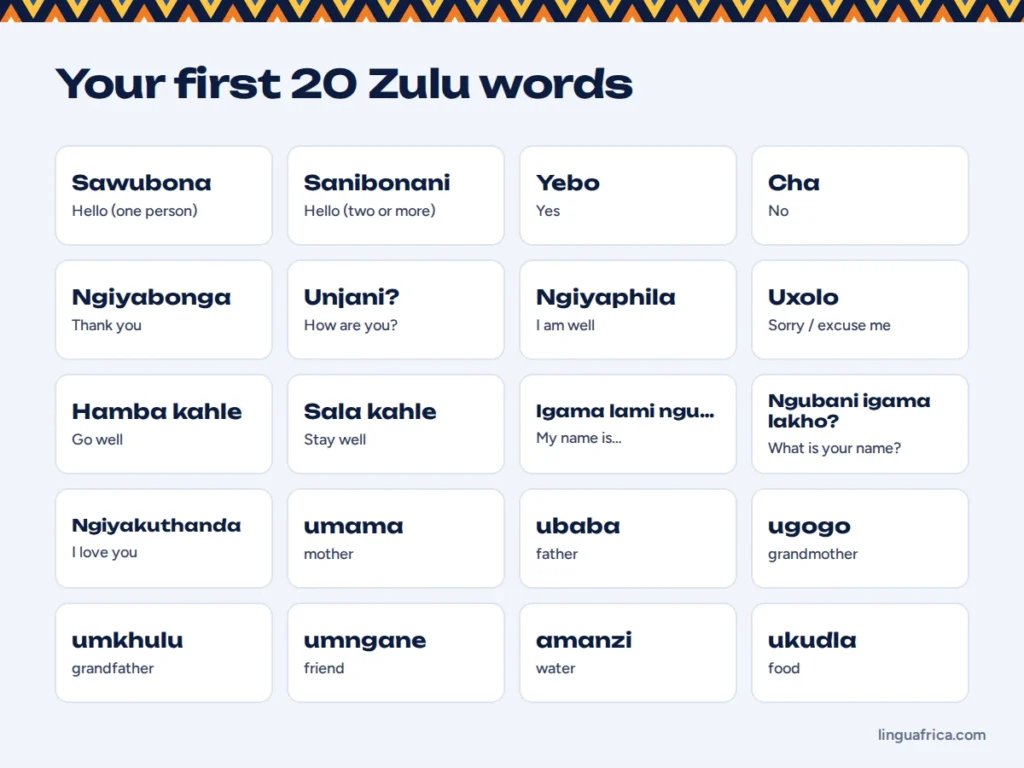
Here are 20 words and phrases that will carry you through your first real conversation. The pronunciation guides are approximate, because some Zulu sounds do not exist in English. The best way to get them right is to listen to a native speaker and copy them.
| # | isiZulu | English | Say it like |
|---|---|---|---|
| 1 | Sawubona | Hello (to one person) | sah-woo-BOH-nah |
| 2 | Sanibonani | Hello (to two or more) | sah-nee-boh-NAH-nee |
| 3 | Yebo | Yes | YEH-boh |
| 4 | Cha | No | click + ah (see the clicks section) |
| 5 | Ngiyabonga | Thank you | ngee-yah-BOHN-gah |
| 6 | Unjani? | How are you? | oon-JAH-nee |
| 7 | Ngiyaphila | I am well | ngee-yah-PEE-lah |
| 8 | Uxolo | Sorry / Excuse me | oo-click-OH-loh |
| 9 | Hamba kahle | Go well (goodbye) | HAHM-bah GAH-hleh |
| 10 | Sala kahle | Stay well (goodbye) | SAH-lah GAH-hleh |
| 11 | Igama lami ngu… | My name is… | ee-GAH-mah LAH-mee ngoo |
| 12 | Ngubani igama lakho? | What is your name? | ngoo-BAH-nee ee-GAH-mah LAH-koh |
| 13 | Ngiyakuthanda | I love you | ngee-yah-koo-TAHN-dah |
| 14 | umama | mother | oo-MAH-mah |
| 15 | ubaba | father | oo-BAH-bah |
| 16 | ugogo | grandmother | oo-GOH-goh |
| 17 | umkhulu | grandfather | oom-KOO-loo |
| 18 | umngane | friend | oom-NGAH-neh |
| 19 | amanzi | water | ah-MAHN-zee |
| 20 | ukudla | food | oo-KOO-dlah |
A few things to notice in this list:
- Prefixes matter. Nouns in Zulu begin with a prefix such as um-, u-, i- or ama-. These prefixes put each noun into a “noun class”, and Zulu has more than a dozen of them. Other words in the sentence change to agree with the class. You do not need to master this now. Just learn each noun with its prefix, as one piece.
- “ph” is not “f”. In Ngiyaphila, the ph is a p with a small puff of air, like the p in “pin”. It is never pronounced like f. The same goes for th (a puffed t) and kh (a puffed k).
- Say “thank you” a lot. Ngiyabonga is one of the most useful words you will learn. For “thank you very much”, say Ngiyabonga kakhulu.
Want to practise these with your children? Turn it into a game. Point at family members and say umama, ubaba, ugogo, or label things around the house: amanzi on the water jug, ukudla on the fridge. Our post on learning Yoruba as a family has more ideas that work for any language.
Is Zulu hard to learn for English speakers?
The honest answer: some parts are easier than you expect, and a few parts take practice.
What makes Zulu easier:
- It uses the same alphabet as English.
- Words are spelled the way they sound. Once you know the rules, you can read almost any word aloud.
- The five vowels are short and clear: a as in “father”, e as in “bed”, i as in “machine”, o as in “for”, u as in “put”.
- The stress usually falls on the second-to-last syllable, as in saw-u-BO-na.
What takes practice:
- Click sounds. Zulu has three basic clicks, written c, q and x. They feel strange at first, but most learners can make them within a few minutes of trying.
- Noun classes. As mentioned above, words change to agree with the noun. This is the biggest grammar challenge, and it comes slowly with exposure.
- Tone. Zulu is a tonal language, which means the pitch of your voice on each syllable matters. The best way to learn tone is by listening, not from a book.
How to make the three Zulu click sounds
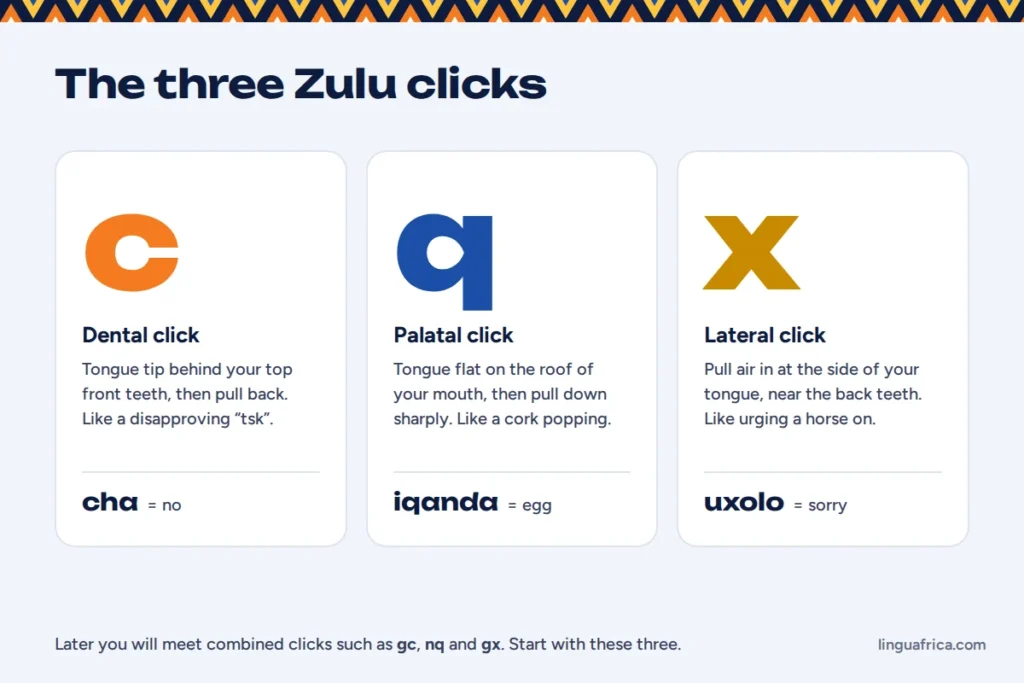
- C (dental click). Put the tip of your tongue just behind your top front teeth and pull it back gently. It is the “tsk tsk” sound English speakers make when they disapprove. You hear it in cha (no) and ukucula (to sing).
- Q (palatal click). Press your tongue flat against the roof of your mouth, then pull it down sharply. It makes a hollow pop, like pulling a cork out of a bottle. You hear it in iqanda (egg).
- X (lateral click). Press your tongue against the roof of your mouth and pull air in at the side of your tongue, near your back teeth. It is the sound some people make to tell a horse to go. You hear it in uxolo (sorry) and ixoxo (frog).
Clicks can also be combined with other sounds, written gc, nq, gx and so on. Do not worry about those yet. Get the three basic clicks comfortable first.
Two more sounds to know
- hl is a breathy sound made by blowing air around the side of your tongue, close to the ll in the Welsh name “Llewellyn”. You hear it in kahle (well) and hlala (sit or stay).
- dl is the voiced partner of hl, as in ukudla (food).
How to learn Zulu: a 7-day starter plan
The secret to learning any language is little and often. Ten minutes a day will take you further than two hours once a week. Here is a simple plan for your first week, using everything in this guide.
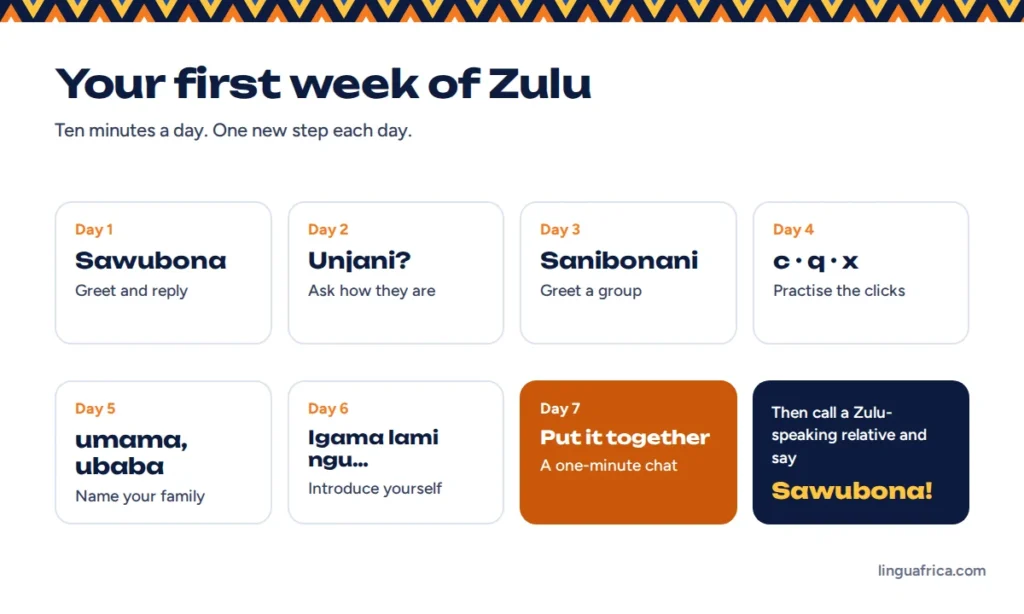
- Day 1: Sawubona. Learn Sawubona and the reply Yebo, sawubona. Say them out loud ten times, then greet someone for real, even if it is just a family member.
- Day 2: How are you? Add Unjani?, Ngiyaphila and wena unjani?. Practise the full five-line conversation from the table above.
- Day 3: One or many. Learn Sanibonani and Ninjani?. Greet your whole household at once.
- Day 4: The clicks. Spend five minutes on c, q and x. Practise cha, iqanda and uxolo until they feel natural.
- Day 5: Family words. Learn umama, ubaba, ugogo and umkhulu. Look at a family photo and name everyone in Zulu.
- Day 6: Introduce yourself. Learn Igama lami ngu… and Ngiyabonga. Introduce yourself out loud, then say thank you.
- Day 7: Put it together. Have a one-minute conversation using everything from the week. Record yourself and compare it with a native speaker. If you have a Zulu-speaking relative, call them and surprise them with Sawubona!
Tips that make it stick
- Listen first. Zulu sounds, tones and clicks are learned with your ears. Play Zulu music, watch videos, and listen to native speakers as often as you can.
- Speak from day one. Do not wait until you feel ready. Every Sawubona you say builds confidence.
- Learn with your children. Kids are fearless with new sounds, and learning together turns practice into play.
- Use an app for daily practice. The Linguafrica app gives you bite-sized Zulu lessons with audio, visuals, storytelling and cultural notes, plus progress tracking and streak rewards to keep you going every day.
Common beginner mistakes to avoid
- Mixing up hamba and sala. Remember: the person leaving says Sala kahle, the person staying says Hamba kahle.
- Saying “f” for “ph”. Ngiyaphila has a puffed p, never an f. The same goes for th and kh, which are a puffed t and k.
- Skipping the greeting. Jumping straight into a question can feel rude. Always start with Sawubona, then ask.
- Using the singular for a group. When you walk into a room full of people, say Sanibonani, not Sawubona.
- Waiting to be perfect. Native speakers are almost always delighted when a learner tries. A warm Sawubona with a few mistakes is far better than silence.
Frequently asked questions
What does Sawubona mean in Zulu?
Sawubona is the standard Zulu greeting for one person. It is usually translated as “I see you”, and its literal meaning is closer to “we see you”. It is used at any time of day, like “hello”, but it also carries a sense of respect: you are recognising the other person.
How do you respond to Sawubona?
Reply with Yebo, sawubona, which means “Yes, I see you too”, or simply Yebo (“Yes”). The conversation usually continues with Unjani? (How are you?), and the answer Ngiyaphila (I am well).
How do you say thank you in Zulu?
Say Ngiyabonga (ngee-yah-BOHN-gah). For “thank you very much”, say Ngiyabonga kakhulu.
Is Zulu hard to learn for English speakers?
Zulu uses the English alphabet and is spelled the way it sounds, which makes reading easy. The parts that take practice are the three click sounds (c, q and x), noun classes and tone. With 10 to 15 minutes of practice a day, most beginners can greet people and introduce themselves within a few weeks.
Are Zulu and Xhosa the same language?
No, but they are close relatives. Both are Nguni languages from South Africa, they share many words, and both use click sounds. Speakers of one can often understand a good part of the other, but they are separate languages with their own vocabulary and pronunciation.
Can children learn Zulu with an app?
Yes. Children are often better than adults at copying new sounds, including the clicks. The Linguafrica app is designed for kids, with short lessons, audio, pictures and stories, and it works just as well for parents learning alongside them.
Sawubona: we see you
Learning Zulu starts with one word, and now you know it. You can greet one person or a whole room, reply when someone greets you, say goodbye the right way, make the three clicks, and use 20 words that matter. That is a real beginning.
Keep going with ten minutes a day, and you will be surprised how quickly the words become your own. When you are ready, see how greetings work in East Africa with our guide to Swahili greetings, listen to our podcast, or read why we started Linguafrica.