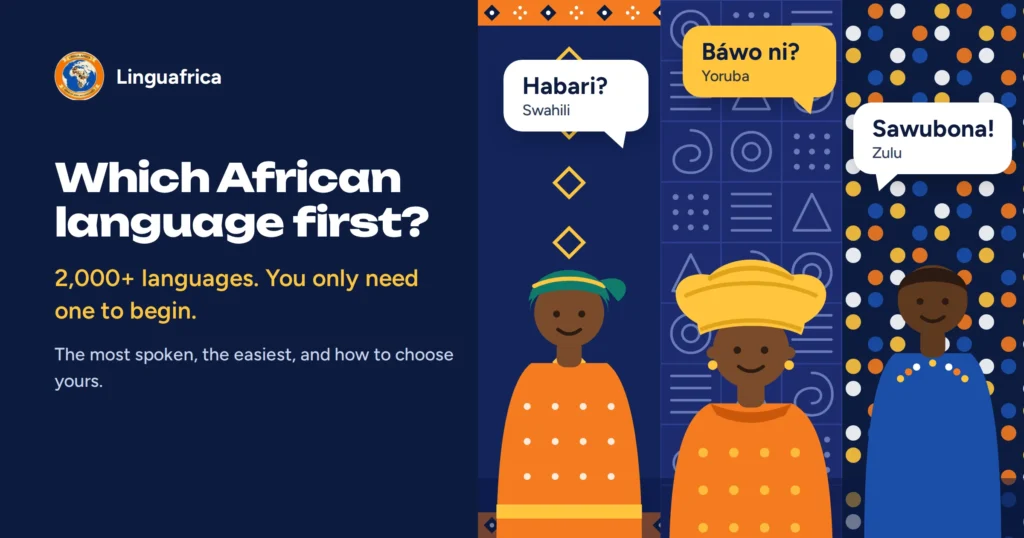
Your grandmother spoke Igbo. Your partner’s family switches into Swahili at every birthday party. Your daughter’s best friend at school is Zulu, and lately she’s been asking what Sawubona means. And you? You’d love to learn an African language, but there are so many that it’s hard to know where to begin.
If that sounds like you, take a breath. You don’t need to learn them all. You need to learn one, and the right one is usually easier to find than you think.
In this guide, we’ll walk you through how many African languages there are, which ones are spoken most, which is the easiest to start with as an English speaker, and how to choose the language that fits your life. We’ll finish with honest advice on teaching your children your mother tongue and choosing a good app for kids. By the end, you’ll have your answer, and a plan.
How many African languages are there?
More than you might imagine. Linguists count somewhere between about 2,100 and 2,300 languages spoken across Africa, depending on how they separate languages from dialects. That’s close to a third of all the languages in the world. Nigeria alone has more than 500.
All those languages belong to a handful of large families, a bit like branches of a family tree:
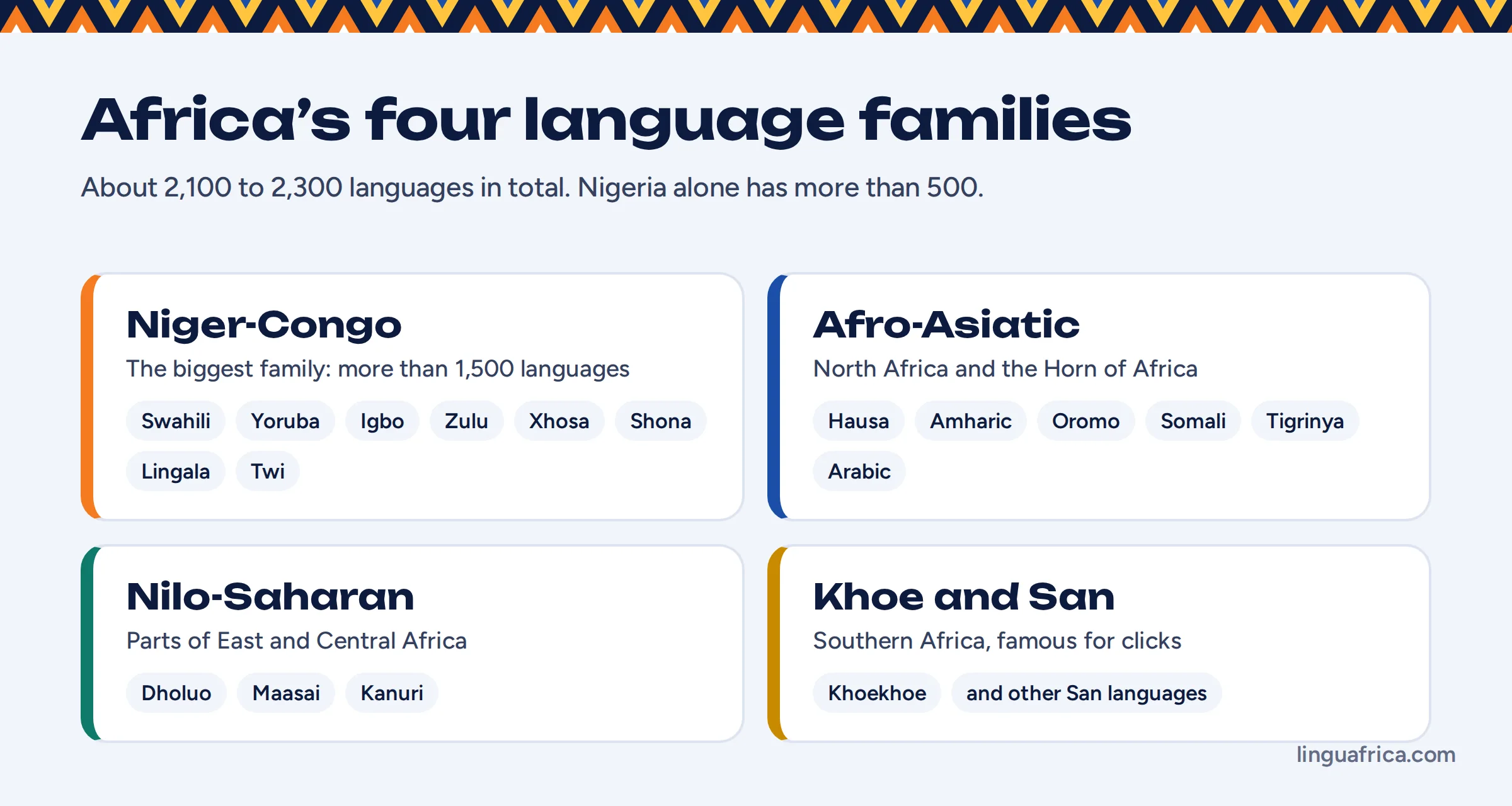
- Niger-Congo is the biggest family, with more than 1,500 languages across West, Central, East and Southern Africa. It includes Swahili, Yoruba, Igbo, Zulu, Xhosa, Shona, Lingala and Twi.
- Afro-Asiatic covers North Africa and the Horn of Africa. It includes Hausa, Amharic, Oromo, Somali and Tigrinya, as well as Arabic.
- Nilo-Saharan languages are spoken in parts of East and Central Africa, including Dholuo (Luo), Maasai and Kanuri.
- Khoe and San languages of southern Africa are famous for their many click sounds. Zulu and Xhosa borrowed some of their clicks from these neighbours long ago.
Why does this matter to you? Because languages in the same family share patterns. Learn one Bantu language, such as Swahili or Zulu, and you’ll notice familiar words and structures in many others. Your first African language makes your second one easier.
Here’s a small example. The word for “person” is mtu in Swahili, umuntu in Zulu and munhu in Shona. Three languages, thousands of kilometres apart, and yet you can hear that they’re cousins. Ubuntu, the famous idea of shared humanity, is built on the same root. Once you start noticing these links, Africa’s languages feel less like a maze and more like one big family.
The most spoken African languages
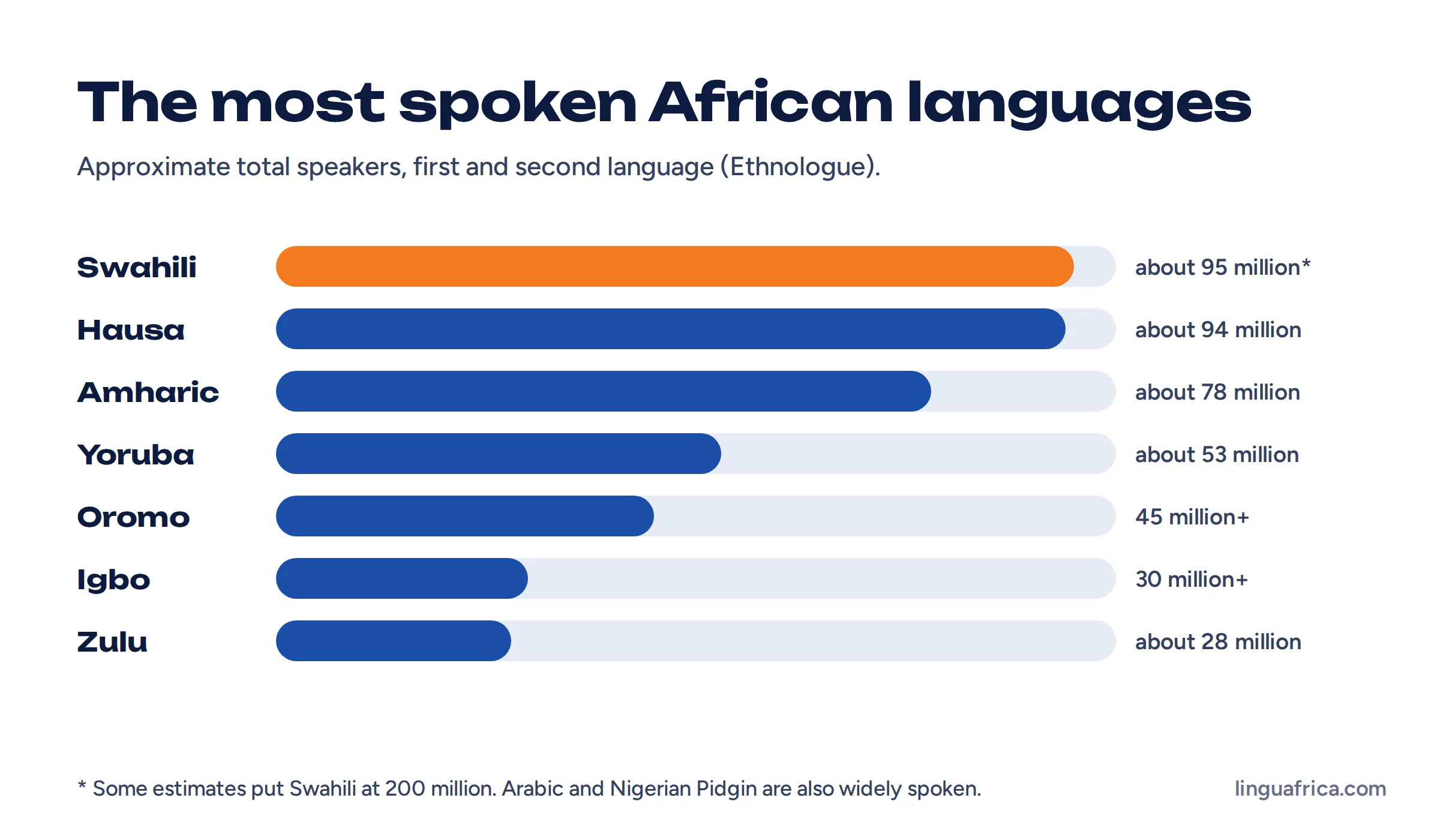
If you want a language that lets you talk to as many people as possible, here are the giants. The numbers below are Ethnologue’s latest estimates of total speakers (first and second language). Different sources give different figures, especially for Swahili (some estimates go as high as 200 million), but the order is broadly agreed.
| Language | Speakers (approx.) | Main countries |
|---|---|---|
| Swahili | 95 million+ | Tanzania, Kenya, Uganda, DR Congo |
| Hausa | 94 million | Nigeria, Niger |
| Amharic | 78 million | Ethiopia |
| Yoruba | 53 million | Nigeria, Benin, Togo |
| Oromo | 45 million+ | Ethiopia, Kenya |
| Igbo | 30 million+ | Nigeria |
| Zulu | 28 million | South Africa |
Two notes to keep things honest. First, Arabic is spoken by well over 100 million people in North Africa, but most lists of “African languages” focus on languages that began on the continent. Second, if you count Nigerian Pidgin, it’s actually one of the most spoken languages in Africa, used by more than 100 million people, mostly as a second language.
What stands out is how many of these languages are lingua francas: languages people use to talk between communities. Swahili links East Africa, Hausa links much of West Africa, and Amharic is the working language of Ethiopia. That’s a big part of why they’re so useful.
What is the easiest African language to learn for English speakers?
The honest answer is Swahili, at least among the big indigenous African languages. Here’s why it’s such a friendly first choice:
- It uses the Latin alphabet, so there’s no new script to learn.
- It isn’t tonal. Unlike Yoruba or Igbo, the pitch of your voice doesn’t change the meaning of a word.
- It’s spelled the way it sounds. Five clear vowels, and almost no silent letters.
- It’s full of familiar words. Swahili has borrowed from Arabic, Portuguese and English over the centuries: kitabu (book, from Arabic), meza (table, from Portuguese), baiskeli (bicycle) and kompyuta (computer).
The US Foreign Service Institute, which trains American diplomats, estimates that English speakers need about 36 weeks of full-time study to reach professional level in Swahili. That’s the same group as German and Indonesian, and much quicker than the 44 weeks it estimates for Zulu, Xhosa, Amharic or Somali.
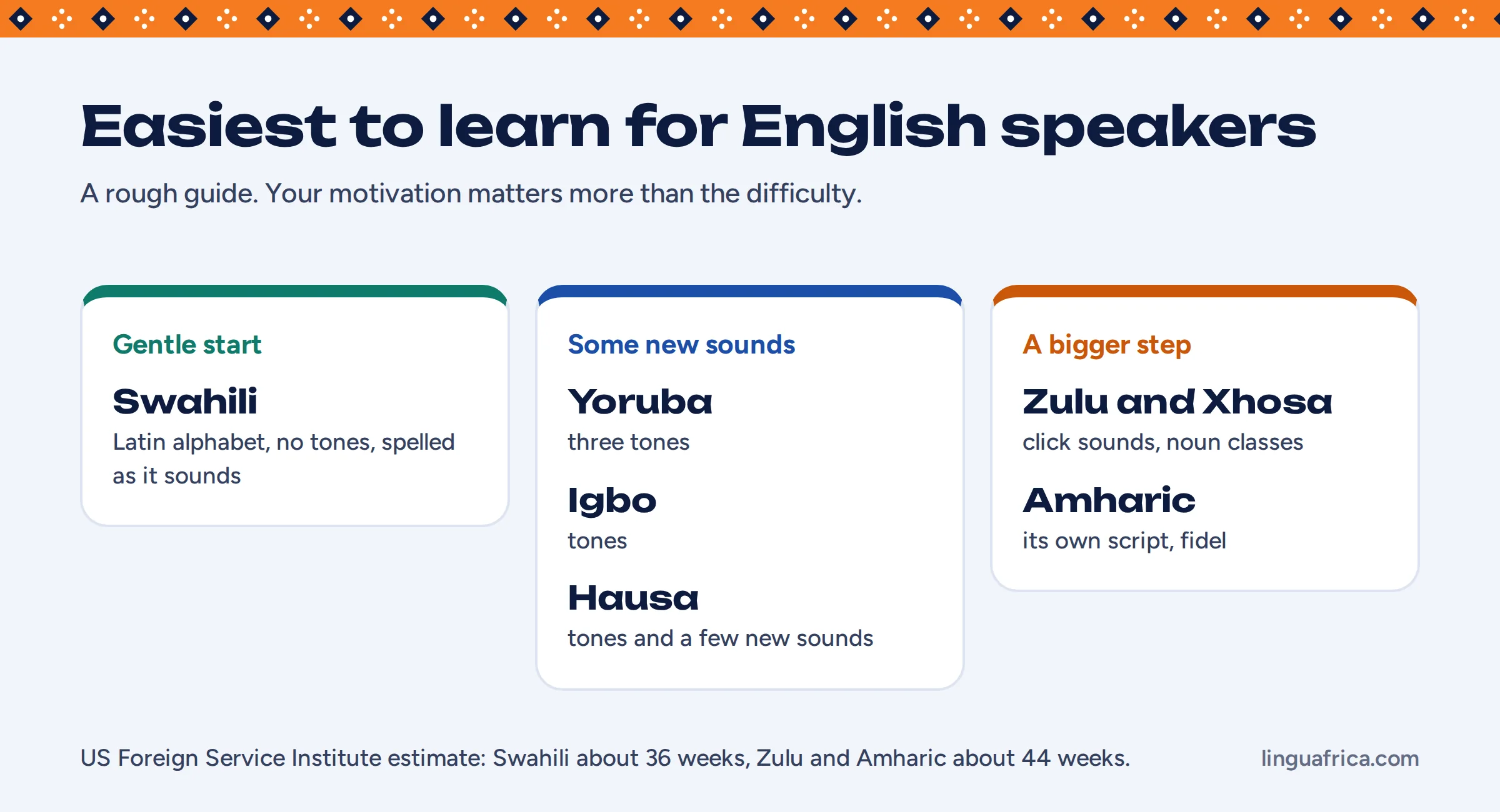
If you’re simply looking for the easiest language spoken in Africa, Afrikaans wins: it grew from Dutch, and the FSI puts it in its easiest group, at about 24 weeks. But most people searching for an “African language” want one with deep African roots, and that’s where Swahili shines.
Here’s how the others compare, in plain terms:
- Zulu and Xhosa: click sounds and noun classes take practice, but the spelling is regular and the clicks are more fun than scary. Our guide to learning Zulu shows you how to make them.
- Yoruba, Igbo and Hausa: tonal languages, so your ears do a lot of the work. They use the Latin alphabet, which helps. See our beginner’s guide to Yoruba for the three tones explained simply.
- Amharic: a beautiful language with its own script, fidel, which has more than 200 characters. A bigger first step, but very rewarding.
One more thing: “easy” is not the same as “right for you”. A language you have a reason to speak will always beat an easy one you don’t care about.
How to choose: start with your why
The best first African language is almost never the “most useful” one on paper. It’s the one with a person, a place or a purpose attached to it. Ask yourself three questions.
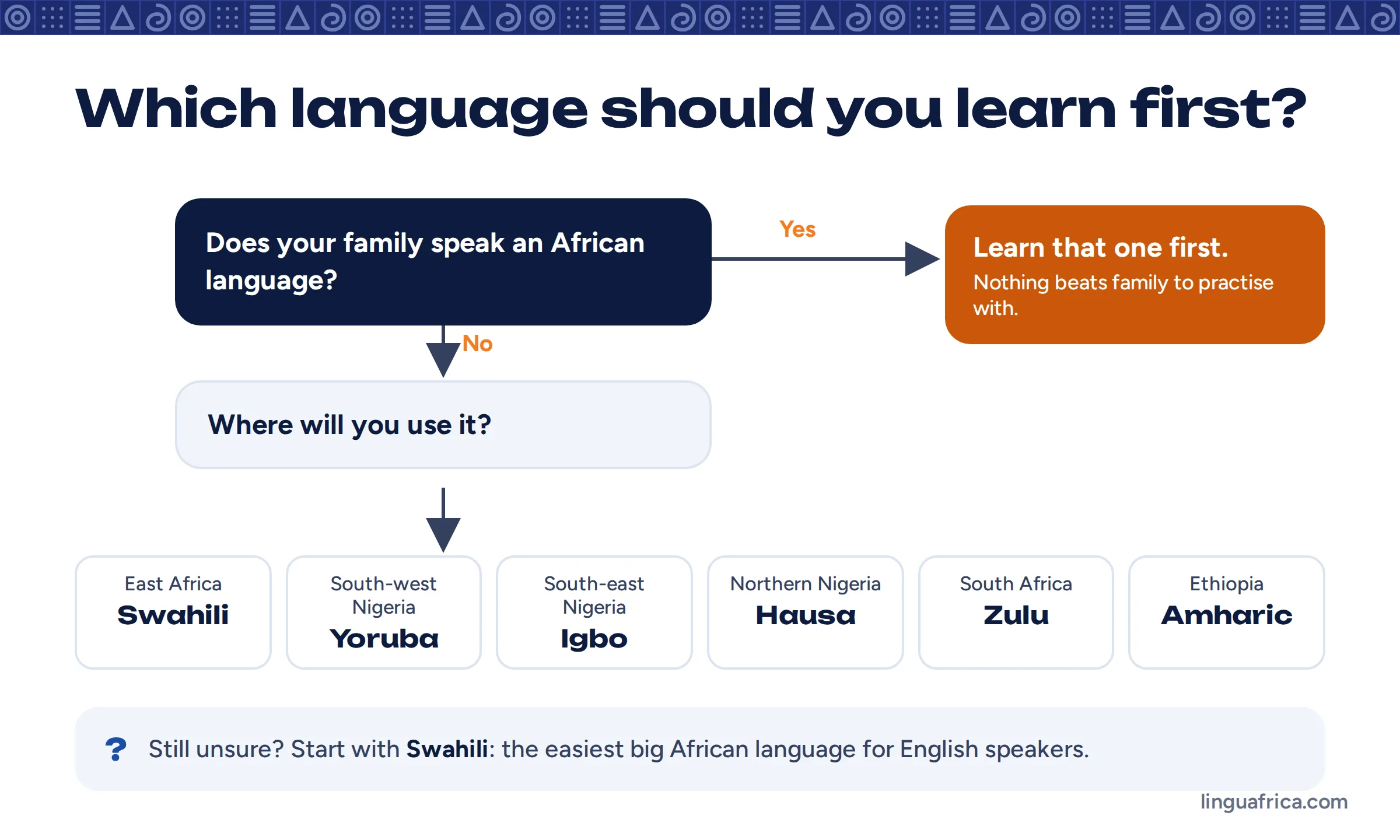
1. Do you have family roots in a language? If your parents or grandparents speak a language, start there. Nothing else comes close. You’ll have people to practise with, a reason to keep going on hard days, and conversations waiting for you that no app can replace. If your family speaks more than one language, choose the one spoken by the people you see most.
2. Where do you want to use it? If there’s no family language, think about the places in your life:
- East Africa (Kenya, Tanzania, Uganda, Rwanda): Swahili.
- Nigeria: Yoruba in the south-west, Igbo in the south-east, Hausa in the north.
- South Africa: Zulu, the most spoken home language, or Xhosa.
- Ethiopia: Amharic.
- Ghana: Twi (Akan) is a great place to start.
3. What will keep you motivated? Music, films, food, faith, travel, a partner’s family: follow what you love. If you adore Afrobeats, Yoruba will meet you in every second song. If you dream of Zanzibar, Swahili is your language. Motivation is the real secret to learning any language.
What if my family speaks two (or more) languages?
This is common, and it’s a lovely problem to have. Maybe your mother speaks Yoruba and your father speaks Igbo, or your family speaks a local language at home and Swahili with everyone else. Here’s a simple rule: choose the language of the people you’ll actually talk to most, and start with that one. Once it feels comfortable, the second language will be easier, because your brain will already be used to switching. You don’t have to choose forever. You’re just choosing what to learn first.
Still unsure? Start with Swahili. It’s the easiest big African language for English speakers, it opens up a whole region, and it gives you a strong foundation for other Bantu languages later. Our guide to Swahili greetings is a lovely first step.
How to teach your child your mother tongue
For many parents, this is the real question. You speak the language, your parents speak it, and you want your children to carry it forward, but life abroad keeps pulling everyone into English.
Here are the approaches families use most, and they work for any African language:
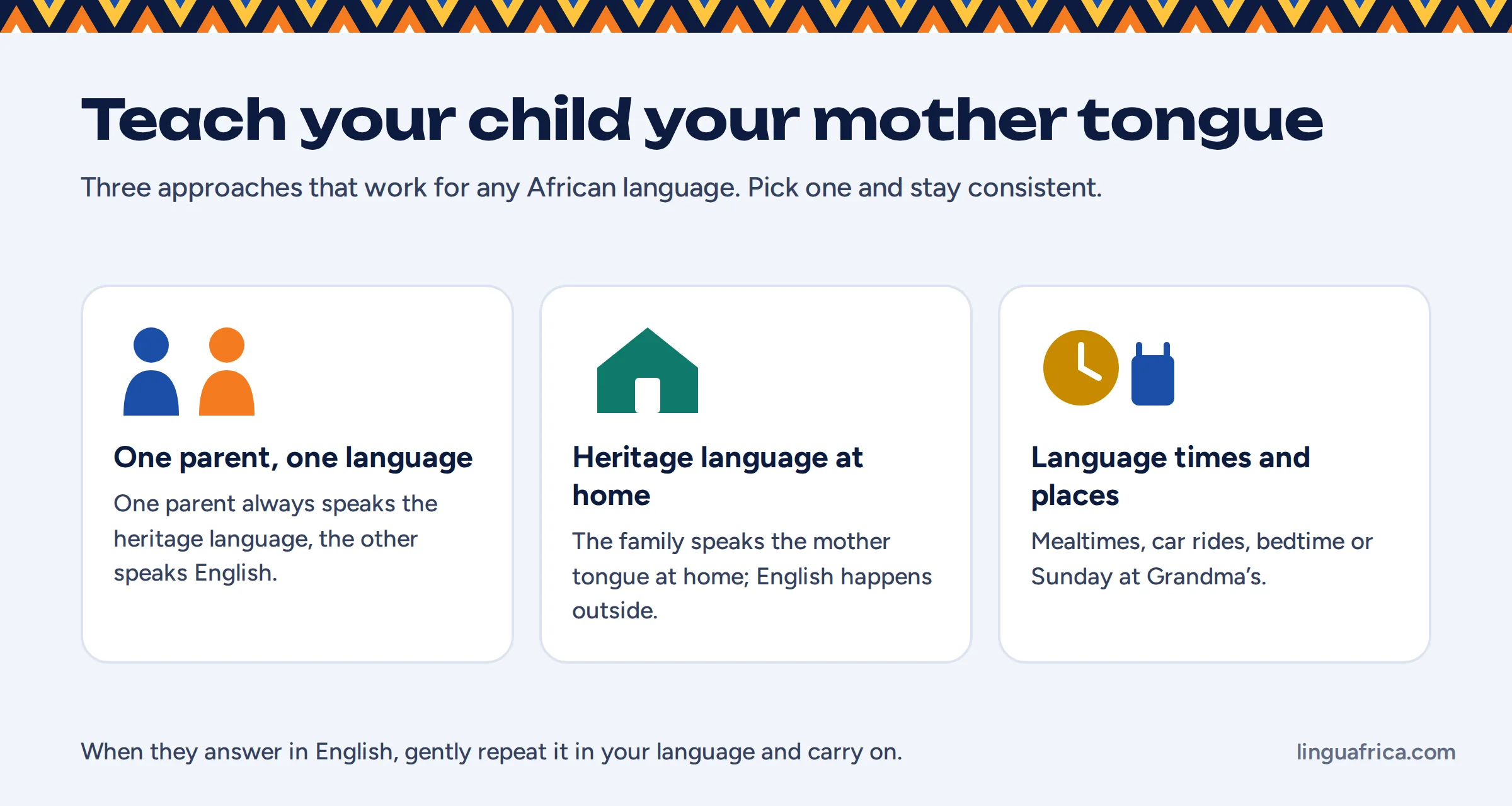
- One parent, one language. One parent always speaks the heritage language to the child, the other speaks English. It’s simple, clear and works well when both parents agree.
- The heritage language at home. The family speaks the mother tongue at home, and English happens at school and outside. This gives the most exposure, which matters a lot.
- Language times and places. If neither of those fits your family, choose moments: mealtimes, car journeys, bedtime stories or Sunday visits to Grandma. Consistency matters more than quantity.
Whichever you choose, a few habits make all the difference:
- Keep going when they answer in English. It’s normal. Gently repeat their answer in your language and carry on. Children understand far more than they say, and speaking comes later.
- Make it joyful. Songs, games, cooking together and silly words stick better than drills. Never make the language feel like a punishment.
- Bring in the grandparents. Video calls with a little mission (“Tell Grandpa what you did at school”) give children a real reason to speak.
- Find a community. Saturday schools, cultural associations, churches and mosques help children see that other kids speak the language too.
- Read and watch in the language. Picture books, cartoons and music give children rich input, even when you’re tired.
- Be patient with yourself. Many parents feel guilty that their children don’t speak the language yet. It’s never too late, and every word counts.
A simple week for language-learning families
You don’t need a big plan. Here’s a gentle rhythm that many families can manage:
- Every morning: greet each other in your language. It takes seconds and sets the tone for the day.
- Every meal: name the food, the drinks and the plates in your language.
- Two evenings a week: read a short picture book or sing one song together.
- Once a week: a video call with a grandparent or relative, with a small mission for your child.
- Every day: five to ten minutes in a kid-friendly language app, so the habit continues even on busy days.
Small, steady and fun. That’s the whole secret.
The best app to learn African languages for kids
An app can’t replace a grandmother, but it can make daily practice easy, especially on busy days. When you’re choosing an app for children, look for:
- Native-speaker audio on every word, so children copy the right sounds and tones.
- Short lessons of five to ten minutes. Little and often wins.
- Pictures, stories and games, not just lists of words.
- Rewards that feel good, like streaks and progress your child can see.
- Culture, not just vocabulary: greetings, respect, songs and stories.
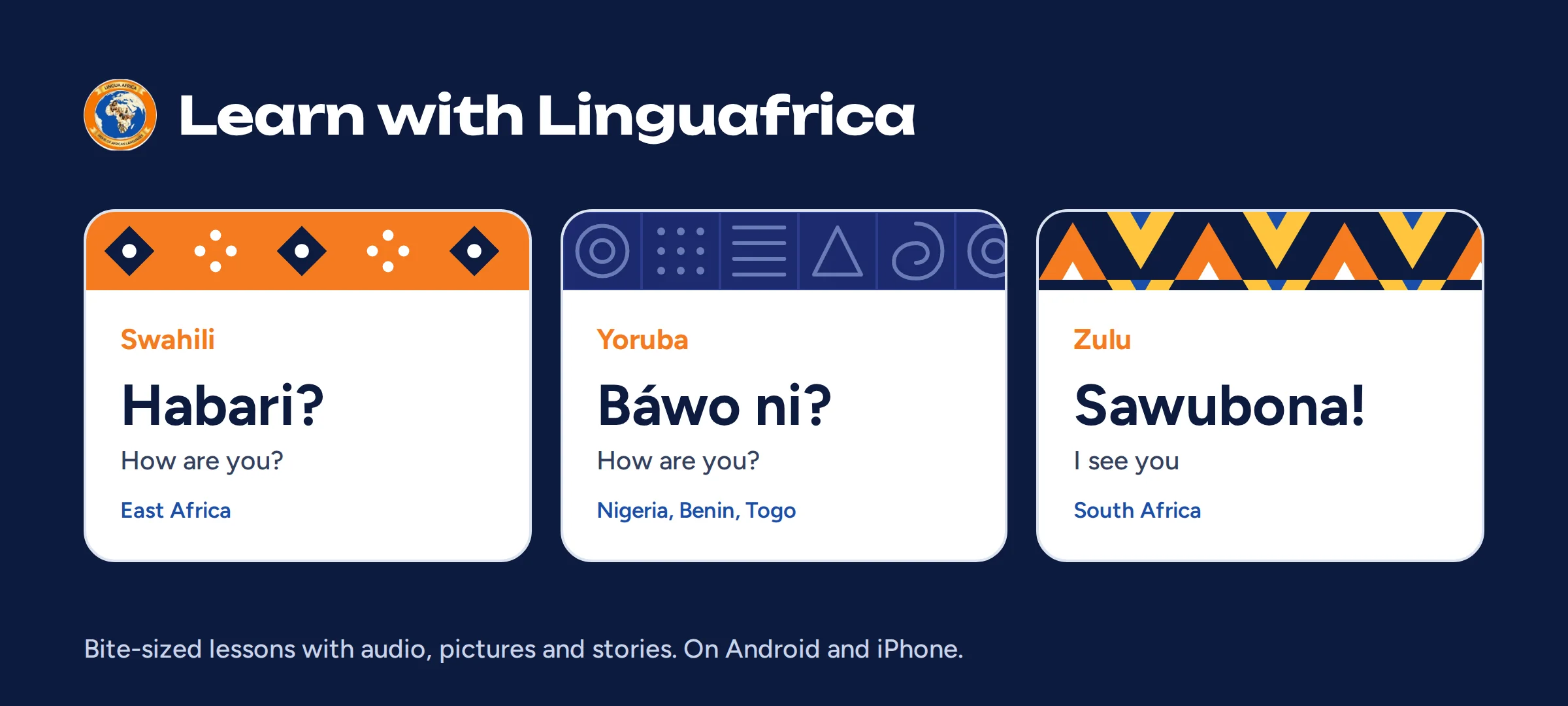
Linguafrica was built for exactly this. We teach Swahili, Yoruba and Zulu in bite-sized lessons with audio, visuals, storytelling and cultural notes, plus progress tracking and streak rewards. It was designed for children first, which makes it friendly for adult beginners too, and it’s available on Android and iPhone.
To be fair to everyone: if your family language is one we don’t teach yet, there are other good options. Nkenne covers languages such as Igbo, Twi, Hausa, Amharic and Somali. Drops has short, visual vocabulary sessions in Yoruba, Igbo and Swahili. Genii Games offers learning games for children in several West and East African languages. Pick whatever your child enjoys most, because enjoyment is what keeps them coming back.
You can see everything we teach on our Languages page.
Frequently asked questions
Which African language should I learn first?
Start with the language your family speaks, if there is one. If not, choose by place: Swahili for East Africa, Yoruba, Igbo or Hausa for Nigeria, Zulu for South Africa and Amharic for Ethiopia. If you’re still unsure, Swahili is the easiest big African language for English speakers.
What is the easiest African language to learn for English speakers?
Among indigenous African languages, Swahili is usually considered the easiest. It uses the Latin alphabet, isn’t tonal and is spelled the way it sounds. The US Foreign Service Institute estimates about 36 weeks of full-time study for Swahili, compared with 44 weeks for Zulu or Amharic. Afrikaans is even quicker, but it comes from Dutch.
What are the most spoken African languages?
By total speakers, the biggest indigenous African languages include Swahili (about 95 million or more), Hausa (about 94 million), Amharic (about 78 million), Yoruba (about 53 million), Oromo, Igbo and Zulu. Arabic and Nigerian Pidgin are also very widely spoken in Africa.
How many languages are spoken in Africa?
Estimates range from about 2,100 to 2,300 languages, depending on how linguists count languages and dialects. Nigeria alone has more than 500.
What is the best app to learn African languages for kids?
Look for native-speaker audio, short lessons, pictures and stories, and rewards. Linguafrica teaches Swahili, Yoruba and Zulu and was designed for children first. Nkenne, Drops and Genii Games cover other African languages.
How can I teach my child my mother tongue?
Choose a clear approach, such as one parent, one language, or speaking the heritage language at home, and stick to it. Keep going even when your child answers in English, make the language fun with songs and games, involve grandparents and find a community of other families.
Can I learn two African languages at the same time?
You can, but it’s usually easier to get comfortable in one first, at least to the level of greetings and simple conversation. Then add the second. If both languages are spoken in your family, you can mix them gently, for example by having one for greetings with each grandparent.
Is Swahili useful outside East Africa?
Yes. Swahili is an official working language of the African Union, it’s taught at universities around the world, and there are large Swahili-speaking communities in the UK, the US and the Middle East. It’s also a great base for learning other Bantu languages, such as Zulu or Lingala.
Is it too late for my child (or me) to learn?
No. Children can pick up a heritage language at any age, and adults learn successfully all the time, especially when they have family to practise with. The best time to start was yesterday; the second best time is today.
Your language is waiting
Out of more than 2,000 African languages, you only need one to begin. Choose the one with a person, a place or a purpose behind it. Start with greetings, keep it to ten minutes a day, and let your family help you.
When you’re ready, read our guide to learning Swahili as a beginner, listen to our podcast, or find out why we started Linguafrica.