
Maybe you’ve booked a trip to Zanzibar. Maybe your partner’s family is from Mombasa and you’re tired of smiling politely through every conversation. Or maybe your children have started asking why Grandma prays, sings and laughs in a language they don’t understand.
Whatever brought you here, you’ve picked a wonderful language. Swahili is warm, musical and, here’s the best part, one of the friendliest African languages for English speakers to learn. You won’t be fluent in a weekend (nobody is, in any language), but you can be greeting people on day one, ordering food in a few weeks and having real conversations in a few months.
This guide shows you exactly how. We’ll answer the big questions (Is Swahili easy? How long does it take?), teach you pronunciation in ten minutes, show you the simple “building blocks” that make Swahili click, give you your first essential words, and finish with a 30-day plan and honest advice on the best apps. Twende! Let’s go!
Is Swahili easy to learn for English speakers?
Honestly? Yes, compared with most languages, and especially compared with most African languages. Here’s why.
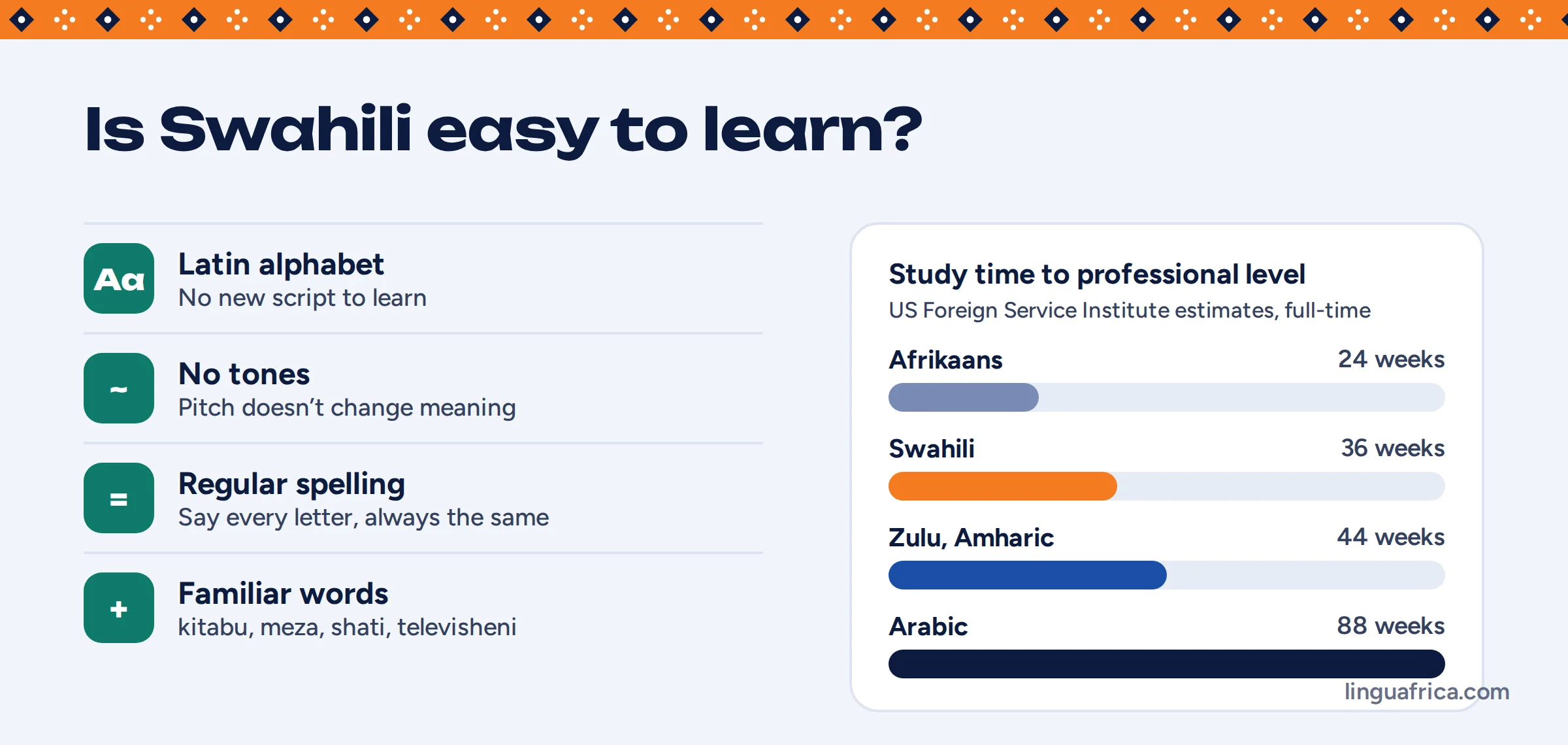
- No new alphabet. Swahili uses the same Latin letters as English.
- No tones. In tonal languages like Yoruba or Igbo, the pitch of your voice changes a word’s meaning. Swahili doesn’t work that way, which makes listening and speaking much simpler.
- What you see is what you say. Swahili spelling is almost perfectly regular. Every letter is pronounced, and the same letter always makes the same sound.
- Lots of familiar words. Over centuries of trade, Swahili borrowed from Arabic, Portuguese, English and other languages: kitabu (book), meza (table), shati (shirt), televisheni (television).
- Logical grammar. Verbs are built from small, predictable pieces, a bit like LEGO. Once you learn the pieces, you can build hundreds of sentences.
The US Foreign Service Institute, which trains American diplomats, puts Swahili in the same group as German and Indonesian. It estimates about 36 weeks of full-time study for English speakers to reach a professional level, compared with about 44 weeks for Zulu or Amharic and 88 weeks for Arabic. That’s for diplomats aiming at professional fluency, though. For everyday conversations, you need far less.
The part that takes a little effort? Noun classes, which we’ll make simple below. They look scary on paper, and they’re surprisingly friendly once you see the pattern.
How long does it take to learn Swahili?
It depends on how much time you give it, but here is a realistic picture for someone practising about 15 to 20 minutes a day:
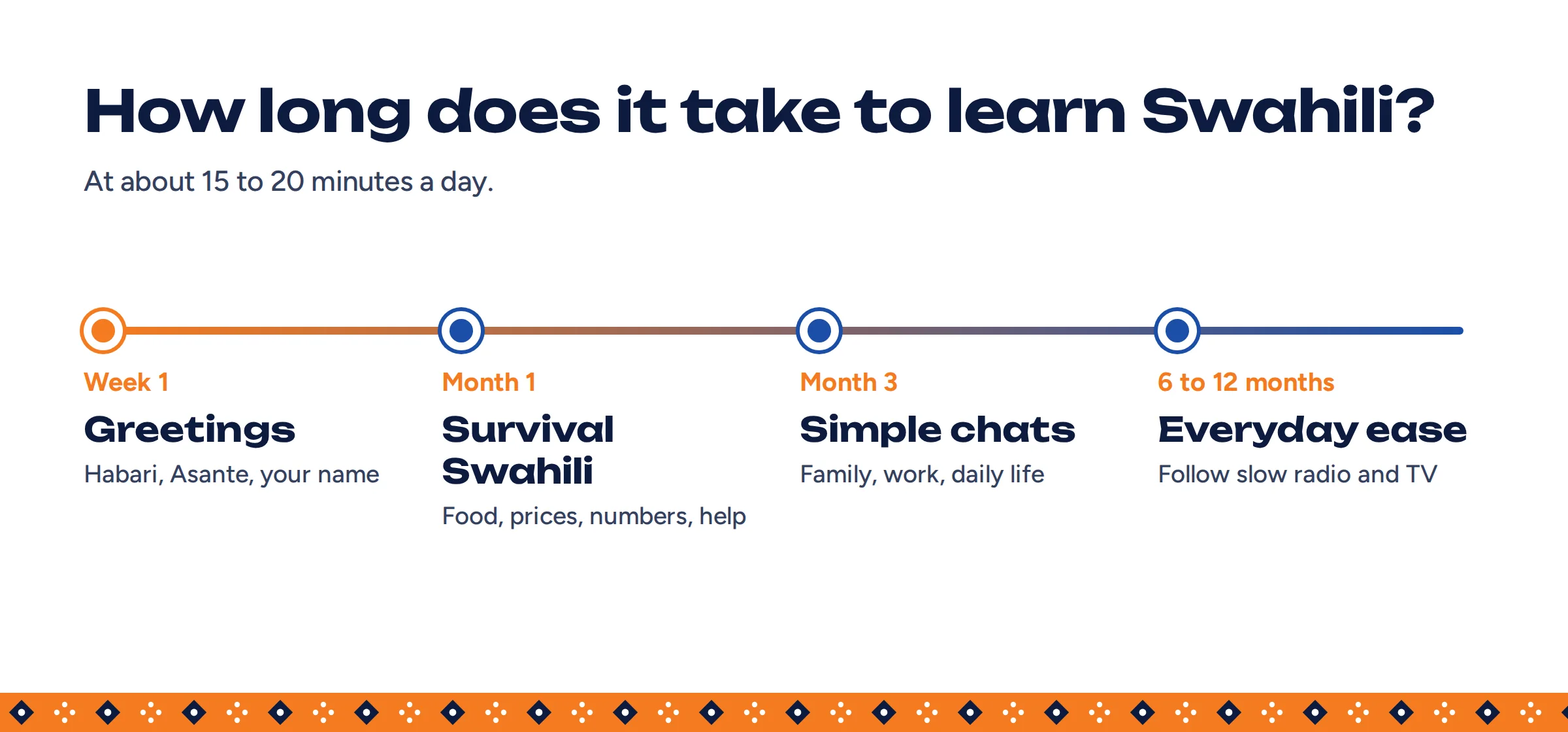
| Time | What you can do |
|---|---|
| Week 1 | Greet people, say thank you, introduce yourself |
| Month 1 | Survival Swahili: order food, ask prices, count, ask for help |
| Month 3 | Simple conversations about family, work and daily life |
| Months 6 to 12 | Comfortable everyday chats, following slow radio or TV |
| 900+ class hours | Professional fluency (the FSI’s estimate) |
Two things speed this up more than anything else. The first is speaking early, even when you feel you’re not ready. The second is listening every day: music, podcasts, radio, family. If you have Swahili-speaking relatives, you have a huge advantage. Use it!
Swahili pronunciation in ten minutes
Here’s the good news: once you know a few simple rules, you can read Swahili aloud with confidence.
The five vowels
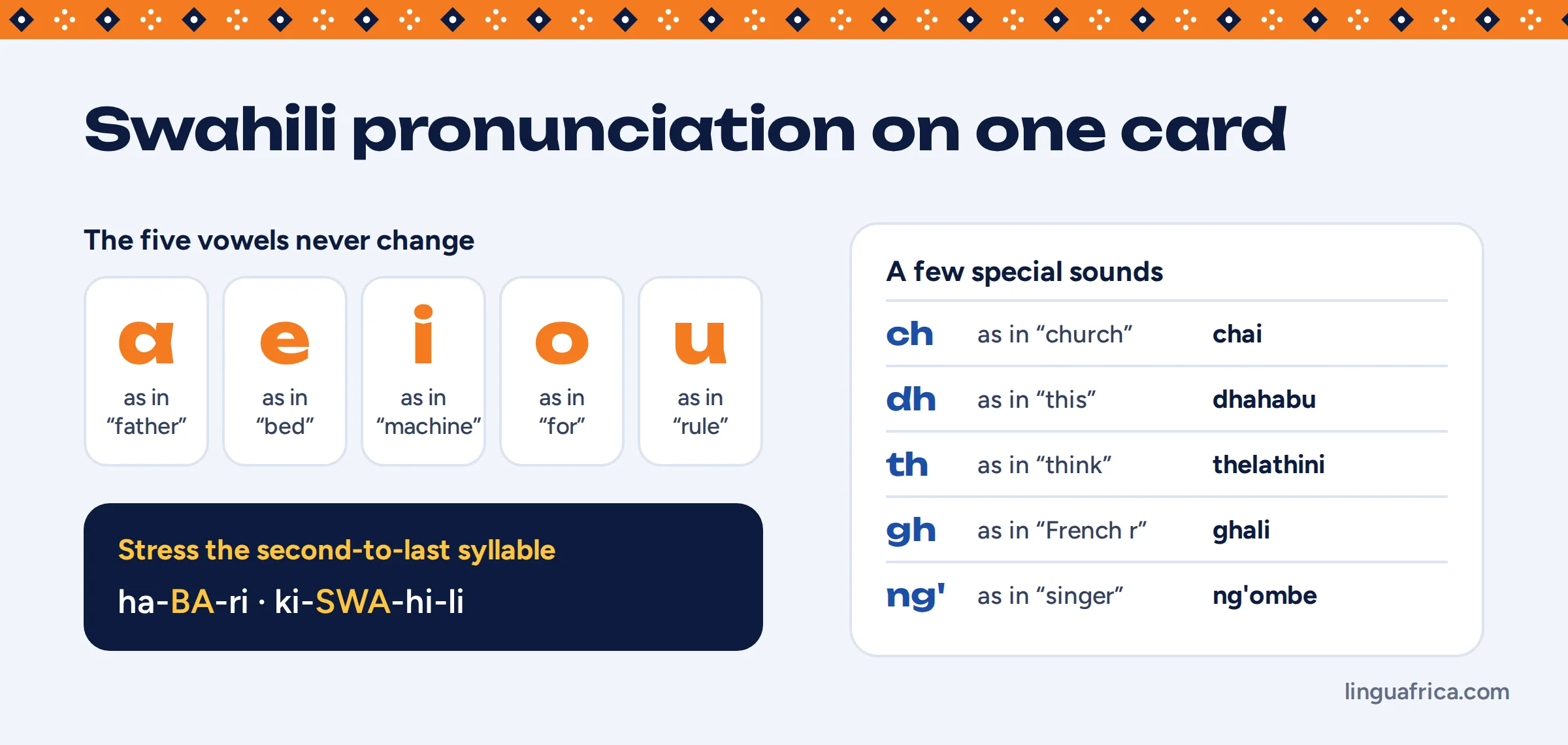
Swahili has just five vowel sounds, and they never change:
- a as in “father”: habari
- e as in “bed”: wewe (you)
- i as in “machine”: kiti (chair)
- o as in “for”: moto (fire)
- u as in “rule”: tatu (three)
When two vowels sit together, say both: saa (hour, clock) is sa-a, and kuona (to see) is ku-o-na.
A few special sounds
- ch as in “church”: chai (tea)
- dh as in “this”: dhahabu (gold)
- th as in “think”: thelathini (thirty)
- gh is a soft, throaty sound, a bit like the French r: ghali (expensive)
- ng’ (with an apostrophe) as in “singer”: ng’ombe (cow)
- r is lightly rolled or tapped, as in Spanish
Where to put the stress
Almost every Swahili word is stressed on the second-to-last syllable: ha-BA-ri, ki-SWA-hi-li, a-SAN-te. Get this right and you’ll instantly sound more natural.
The building blocks: how Swahili sentences work
Swahili grammar rests on two big ideas, plus a very simple way to ask questions. Learn them, and the language opens up.
1. Verbs are built like LEGO
A Swahili verb is made of small pieces stuck together: who + when + action.
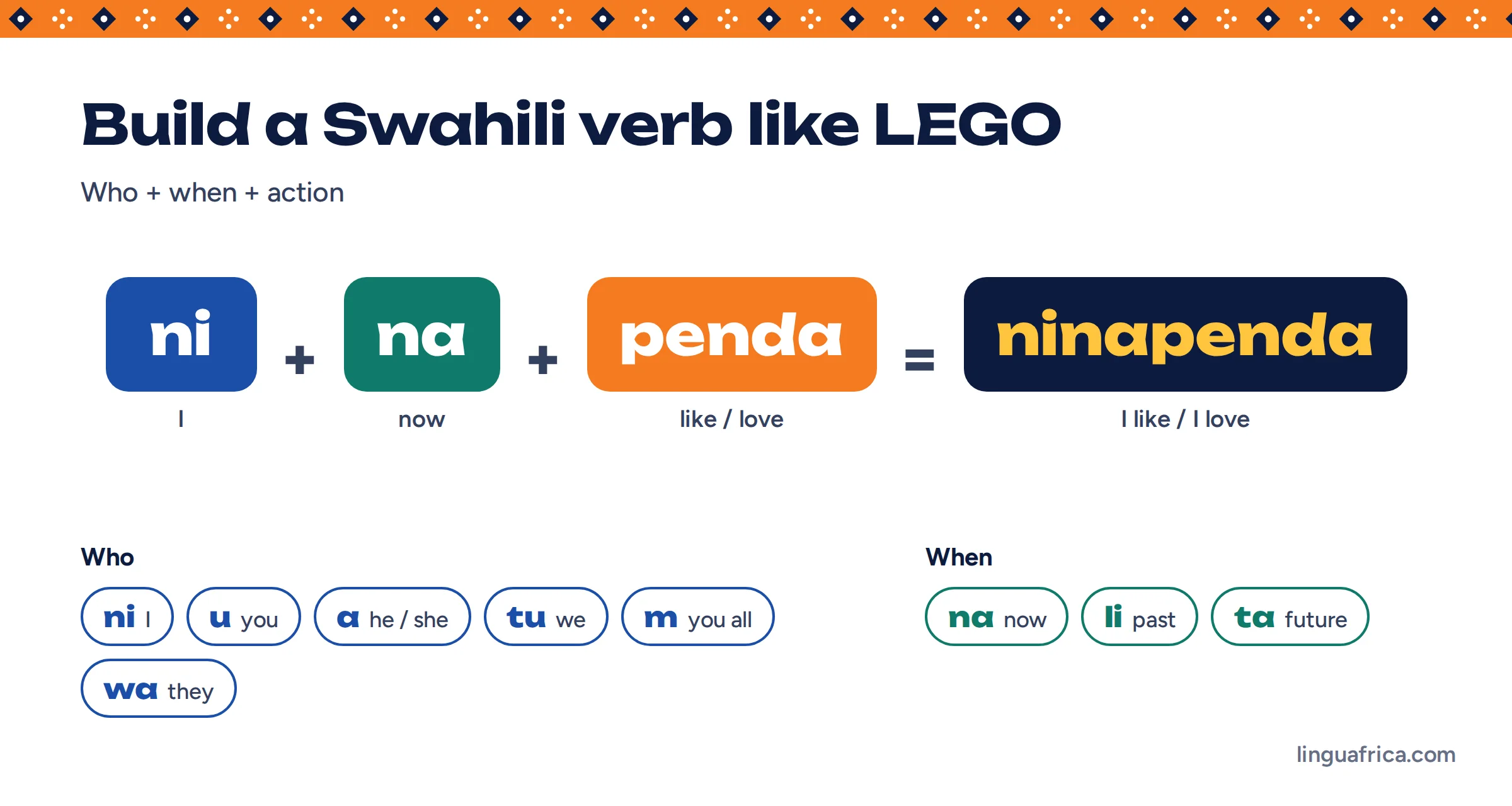
Take the verb -penda (like or love):
- ni (I) + na (now) + penda = ninapenda: I like / I love
- u (you) + na + penda = unapenda: you like
- a (he or she) + na + penda = anapenda: he or she likes
- tu (we) + na + penda = tunapenda: we like
Now change the time piece:
- na = now: ninapenda (I like)
- li = past: nilipenda (I liked)
- ta = future: nitapenda (I will like)
Swap in another verb, such as -soma (read), -kula (eat, which keeps its ku- in short forms: ninakula) or -enda (go), and the same pattern works. That’s dozens of sentences from just a few pieces. And notice: Swahili has no separate word for “he” or “she” here. Anapenda covers both.
And one sentence everyone should know: Nakupenda means “I love you”. The ku in the middle means “you”.
2. Nouns come in families (noun classes)
Swahili sorts nouns into groups called noun classes. Each class has its own prefix for one and for many. You don’t need to learn them all at once; start with three:
| Class | One | Many | Meaning |
|---|---|---|---|
| People (m- / wa-) | mtu | watu | person / people |
| People (m- / wa-) | mtoto | watoto | child / children |
| Things (ki- / vi-) | kitabu | vitabu | book / books |
| Things (ki- / vi-) | kiti | viti | chair / chairs |
| Trees and plants (m- / mi-) | mti | miti | tree / trees |
See the pattern? To make a plural, you change the beginning of the word, not the end. Other words in the sentence often change to match, but you’ll pick that up naturally by listening. For now, learn each new noun with its plural, as a pair.
3. Asking questions is easy
Swahili question words usually go at the end of the sentence, and your voice rises a little, just like in English:
- nini? what? Unataka nini? What do you want?
- wapi? where? Unaenda wapi? Where are you going?
- lini? when? Utarudi lini? When will you come back?
- nani? who? Wewe ni nani? Who are you?
- kwa nini? why? Kwa nini? Why?
Learn these five, and you can keep almost any conversation going, even when you only know a few words.
Your first essential Swahili words and phrases
These are the words that will carry you through your first weeks, whether you’re at the market in Dar es Salaam or at the dinner table with family. If you want to go deeper on greetings, our full guide to Swahili greetings and how to reply has everything.
Everyday phrases
- Habari? How are you? Reply: Nzuri (fine).
- Asante (sana). Thank you (very much).
- Karibu. Welcome / you’re welcome.
- Ndiyo / Hapana. Yes / No.
- Tafadhali. Please.
- Samahani. Excuse me / sorry.
- Jina langu ni… My name is…
- Sielewi. I don’t understand.
- Sema polepole, tafadhali. Speak slowly, please.
- Bei gani? How much is it?
- Sawa. OK.
- Nakupenda. I love you.
Counting from 1 to 10
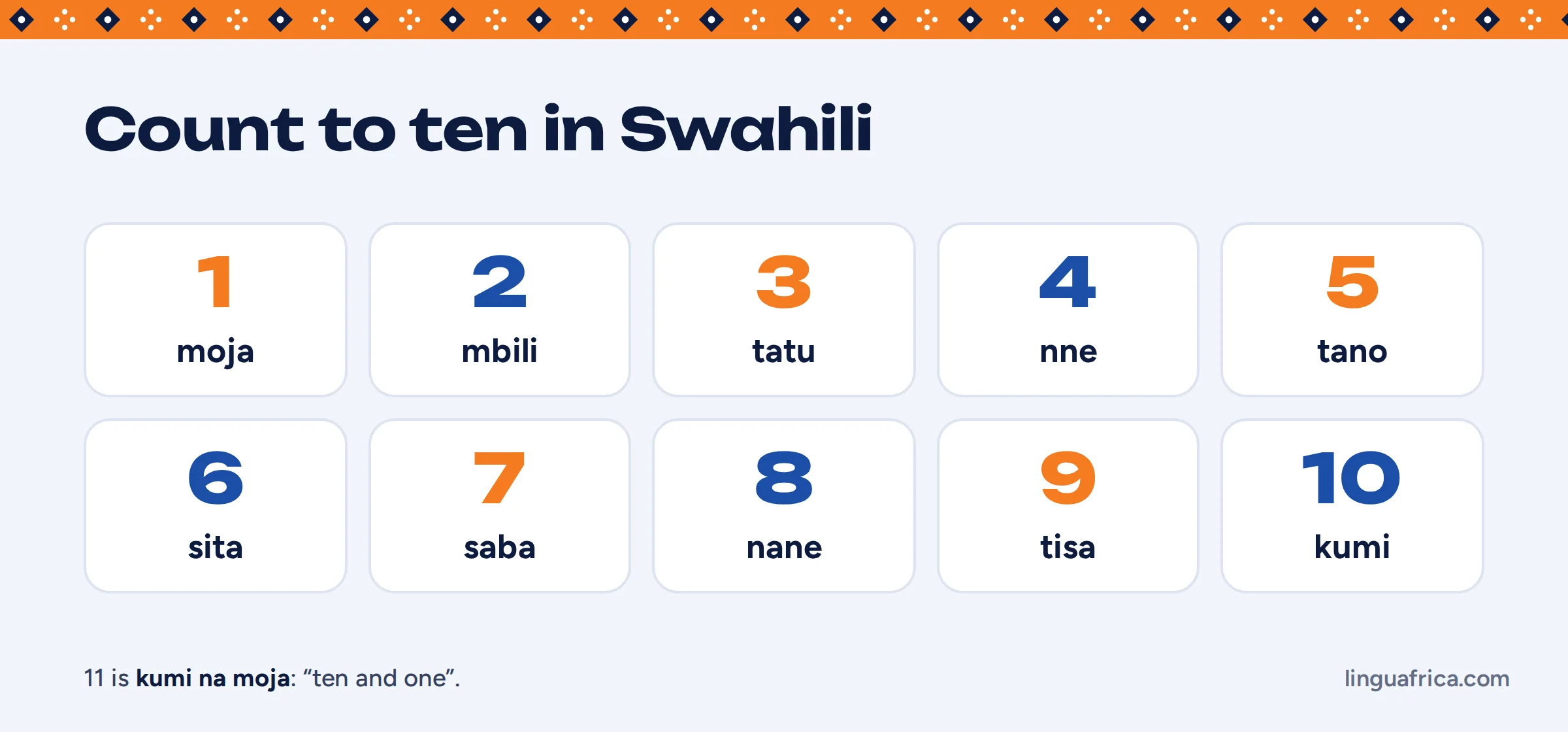
| Number | Swahili | Say it like |
|---|---|---|
| 1 | moja | MO-ja |
| 2 | mbili | m-BEE-lee |
| 3 | tatu | TA-too |
| 4 | nne | n-neh |
| 5 | tano | TA-no |
| 6 | sita | SEE-ta |
| 7 | saba | SA-ba |
| 8 | nane | NA-neh |
| 9 | tisa | TEE-sa |
| 10 | kumi | KOO-mee |
Fun fact: sita, saba and tisa come from Arabic, a reminder of the centuries-old trade along the East African coast.
How to learn Swahili fast: a 30-day plan
“Fast” doesn’t mean cramming. It means practising a little every single day, so your brain never forgets what it learned yesterday. Here’s a simple plan for your first month, about 15 to 20 minutes a day.
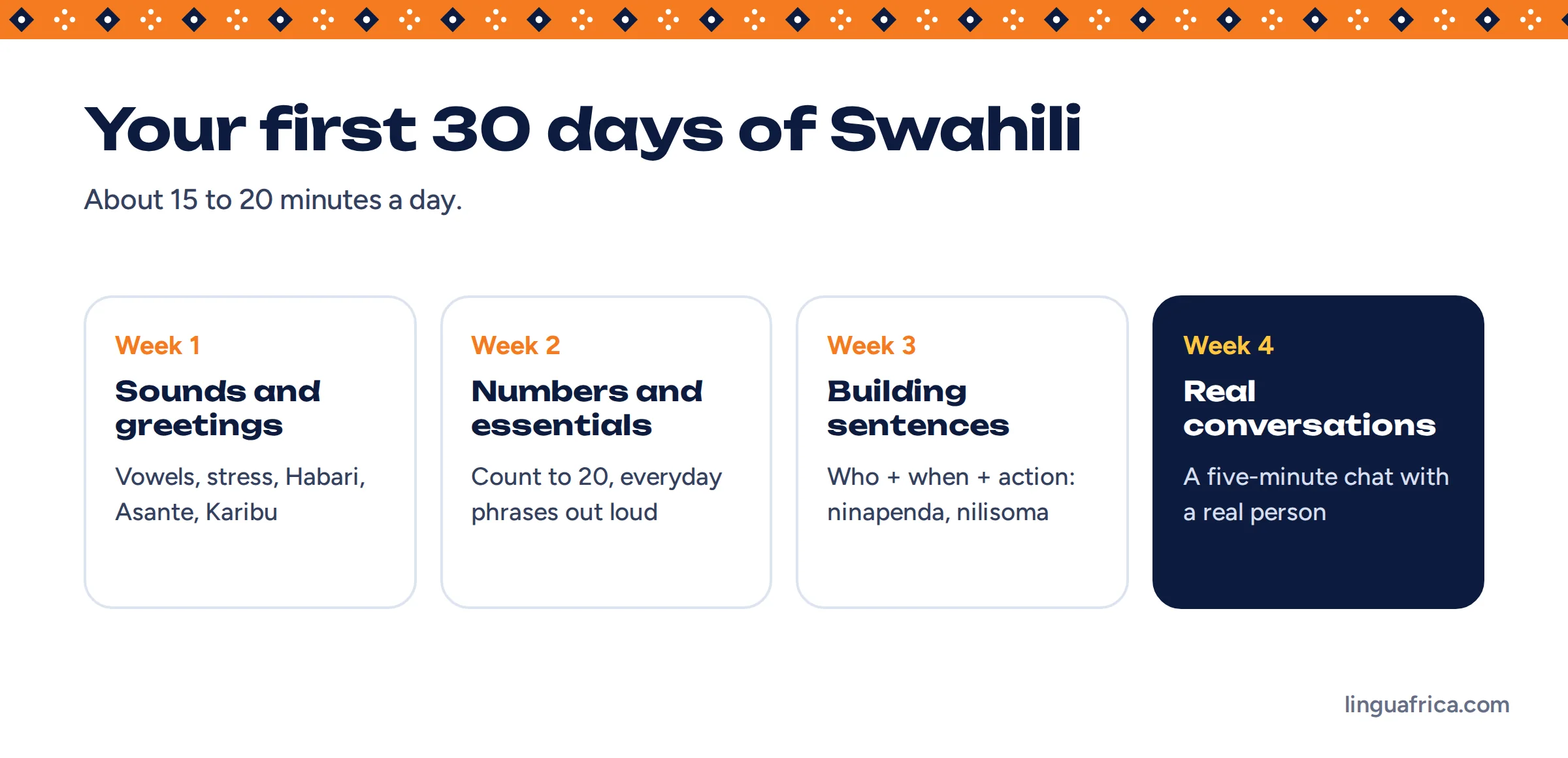
- Week 1: Sounds and greetings. Learn the five vowels and the stress rule. Master Habari, Nzuri, Asante and Karibu. Greet someone in Swahili every day.
- Week 2: Numbers and essentials. Count to ten, then to twenty (kumi na moja is eleven, literally “ten and one”). Learn the everyday phrases above and use them out loud.
- Week 3: Building sentences. Learn the verb pieces ni, u, a, tu and the times na, li, ta. Make ten sentences a day about your real life: Ninapenda chai (I like tea), Nilisoma kitabu (I read a book).
- Week 4: Real conversations. Have a five-minute chat with a relative, a friend or a tutor. Introduce yourself, talk about your family and ask questions. Write down the new words you hear.
Tips that make it stick
- Listen while you live. Play Swahili music while you cook (Tanzanian Bongo Flava is a great start), and try news from BBC News Swahili or DW Kiswahili once you’re ready for a challenge.
- Shadow native speakers. Play a short sentence, pause, and repeat it out loud with the same rhythm. It’s one of the fastest ways to improve pronunciation.
- Learn phrases, not lists. “Bei gani?” is more useful than memorising the word for price on its own.
- Talk to yourself. Describe what you’re doing in simple Swahili: Ninakula. Ninasoma. Ninaenda kazini (I’m eating, I’m reading, I’m going to work).
- Don’t fear mistakes. Swahili speakers are famously welcoming to learners. A sentence with mistakes still gets a big smile and a Karibu!
Common beginner mistakes
- Stressing the wrong syllable. Remember: second-to-last. It’s ha-BA-ri, not HA-ba-ri.
- Changing the end of a noun for plurals. In Swahili, the change happens at the start: kitabu becomes vitabu, not “kitabus”.
- Skipping greetings. Asking a question without greeting first can feel rude. Start with Habari or Shikamoo for elders.
- Waiting to be perfect. The fastest learners are the ones who speak badly at first and keep going.
The best apps to learn Swahili (for adults and kids)
The right app turns ten spare minutes into real progress. Here’s an honest look at the main options. Yes, one of them is ours, so we’ll be upfront about that.
- Linguafrica. Our app teaches Swahili (plus Yoruba and Zulu) in bite-sized lessons with audio, visuals, storytelling and cultural notes, with progress tracking and streaks. It was designed for children first, which makes it one of the best options if you’re learning as a family, and it’s gentle for adult beginners too. Available on Android and iPhone.
- Duolingo. Duolingo does have a Swahili course, and its game-style lessons are great for building a daily habit. It’s a good companion for vocabulary and sentence patterns.
- Drops. Short, picture-based sessions that are perfect for growing your vocabulary.
- Audio courses such as Pimsleur. Good if you learn best by listening, for example during a commute.
- A tutor. Sites like Preply and italki have Swahili tutors who can correct your speaking and answer questions. One lesson a week makes a big difference.
For kids
Children learn Swahili best through play, songs and stories. Linguafrica was built for exactly that. For extra listening, look for Swahili children’s cartoons such as Akili and Me by the Tanzanian studio Ubongo, which teaches early learning skills in Swahili. Combine a few minutes of app practice with Swahili greetings at home, and your children will surprise you.
Learning Swahili as a family
Learning together is one of the best ways to keep going. Pick one “Swahili moment” each day, such as breakfast, the school run or bedtime, and use only Swahili for a few minutes. Count the stairs in Swahili (moja, mbili, tatu…), say Asante at every meal, and end the day with Lala salama (sleep well). Children love catching their parents’ mistakes, and parents are often amazed at how quickly children overtake them. Celebrate every small win together.
If you’re still deciding between languages, our guide to which African language to learn first compares the options, and our Languages page shows everything we teach.
Frequently asked questions
How can I learn Swahili fast as a beginner?
Practise a little every day rather than a lot once a week. Start with pronunciation and greetings, learn the simple verb pattern (who + when + action), use a short daily app lesson, listen to Swahili music or radio, and speak with a real person as early as you can.
How long does it take to learn Swahili?
With about 15 to 20 minutes a day, most beginners can handle greetings in a week, survival phrases in a month and simple conversations in about three months. The US Foreign Service Institute estimates about 900 class hours for professional fluency.
Is Swahili easy to learn for English speakers?
Yes, compared with most languages. It uses the Latin alphabet, isn’t tonal, is spelled the way it sounds and has many borrowed words. The main new idea is noun classes, which become natural with practice.
Can I learn Swahili on Duolingo?
Yes. Duolingo offers a Swahili course, which is useful for daily practice and vocabulary. Many learners combine it with an app that focuses on culture and speaking, such as Linguafrica, plus listening and a tutor or family member to talk to.
What is the best app to learn Swahili for kids?
Look for short lessons, native audio, pictures, stories and rewards. Linguafrica was designed for children first and teaches Swahili, Yoruba and Zulu. Swahili cartoons such as Akili and Me are also great for listening practice.
Is Kenyan Swahili different from Tanzanian Swahili?
It’s the same language. Tanzania tends to use more formal, standard Swahili, while Kenyans often mix in English and slang, especially in cities. If you learn standard Swahili, you’ll be understood in both countries.
How do you say “how are you” in Swahili?
The most common way is Habari? (literally “What’s the news?”), answered with Nzuri (“fine”). With friends you’ll also hear Mambo?, answered with Poa. With elders, start with Shikamoo.
How do you say “I love you” in Swahili?
Say Nakupenda (na-koo-PEN-da). The ku in the middle means “you”. It’s one of the most searched Swahili phrases, and one of the loveliest to say to family.
Twende: let’s go!
Swahili rewards every minute you give it. In a week you can greet people, in a month you can find your way around a market, and in a few months you can sit at the family table and actually follow the conversation. That’s not a dream. It’s ten or twenty minutes a day.
So start today: say Habari to someone, count to ten while you make tea, and build your first sentence with ninapenda. When you want more, listen to our podcast or read why we started Linguafrica. You might also enjoy discovering Zulu’s “Sawubona” and Yoruba’s three tones once Swahili feels at home.