
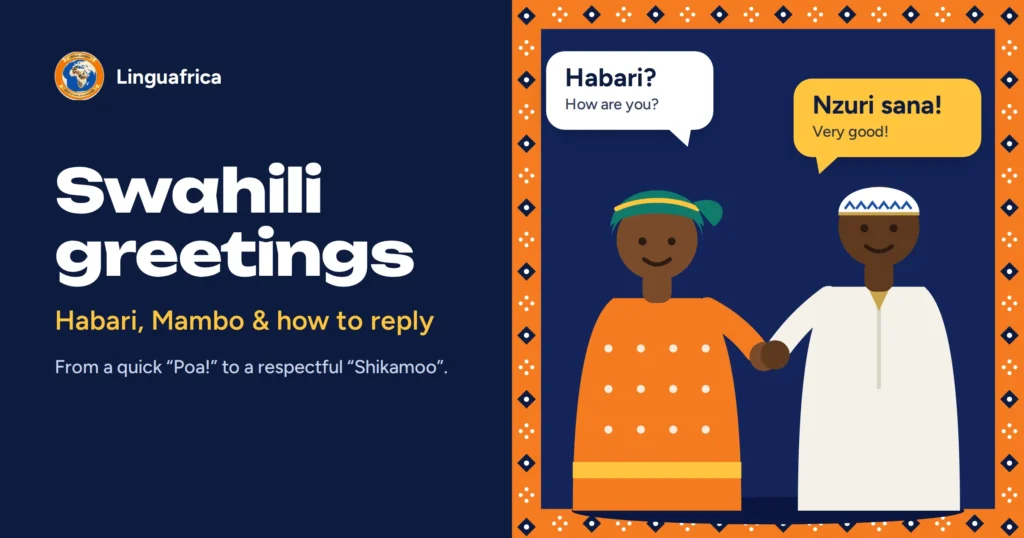
You step out of the airport in Dar es Salaam or Nairobi, and the very first person you meet smiles and says, “Mambo!” You smile back. You know you’re supposed to answer. But what do you say?
Or maybe you’re at a family gathering in Birmingham, and an auntie greets your children with a long, warm stream of Swahili. They freeze, and you wish you’d taught them just a few words.
Here’s the secret: in Swahili, the greeting is the conversation. People don’t rush past it. They ask about your news, your morning, your family and your work, and they wait to hear the answer. Learn the greetings and the replies, and you’ve already learned the most important part of the language.
This guide gives you everything you need: the greeting you’ll hear most (Habari) and how to reply, good morning, afternoon and evening, the casual greetings young people use, the respectful Shikamoo for elders, and how to say thank you, welcome and goodbye. Karibu sana. You’re very welcome.
Why Swahili greetings matter so much
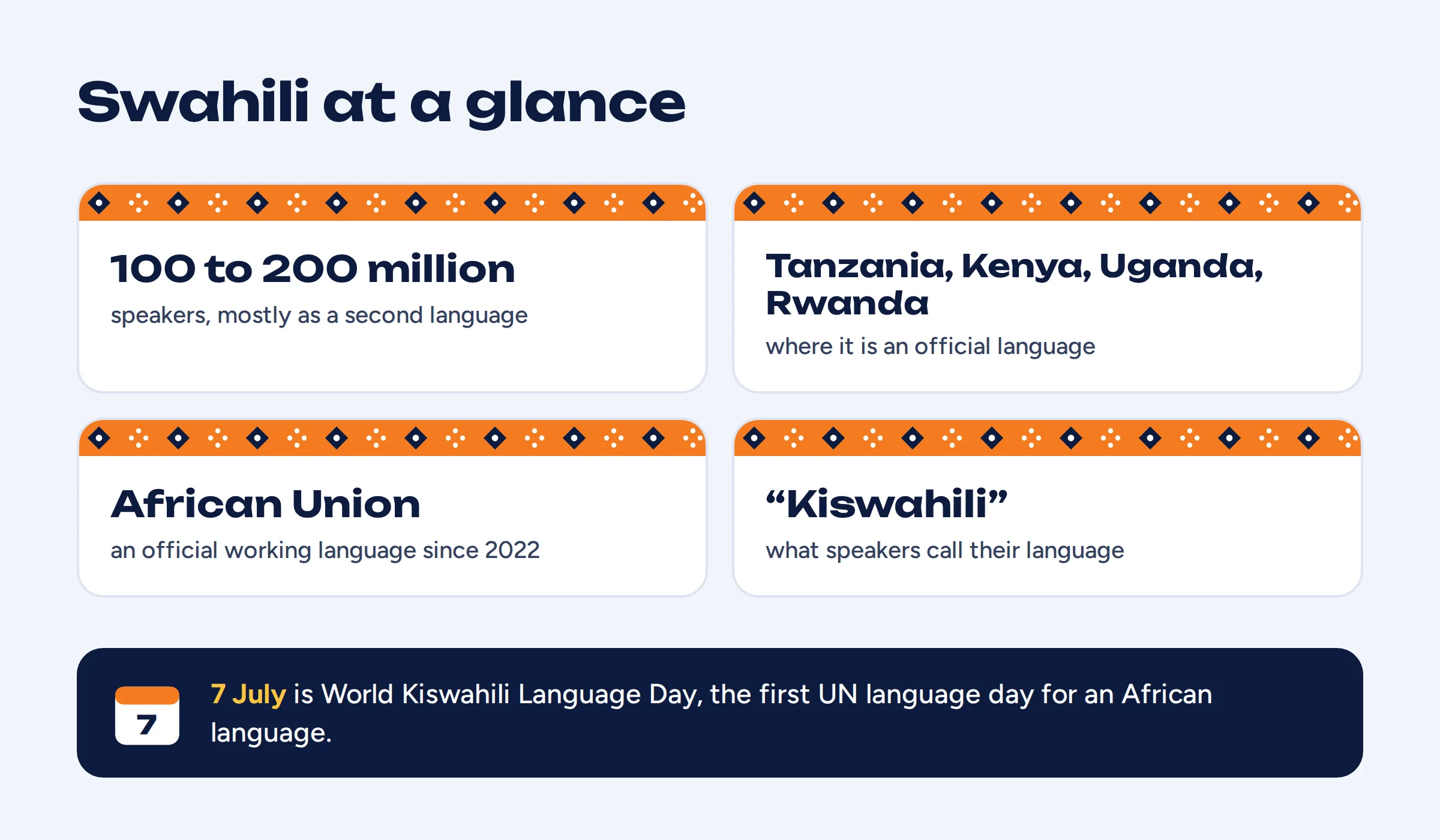
Swahili, called Kiswahili by its speakers, is the great shared language of East Africa. Estimates of how many people speak it range from about 100 million to more than 200 million, because most speakers use it as a second or third language alongside their own home language. It’s an official language in Tanzania, Kenya, Uganda and Rwanda, a national language in the Democratic Republic of the Congo, and an official working language of the African Union.
It even has its own day. Since 2022, the world has celebrated World Kiswahili Language Day every 7 July. It was the first African language to be honoured with a United Nations language day. The date wasn’t chosen at random: on 7 July 1954, Julius Nyerere’s party TANU adopted Swahili as the language that would unite people in the struggle for independence in what is now Tanzania.
But numbers don’t tell you how Swahili feels. What surprises most visitors is how much time people spend greeting each other. A quick “hi” and straight down to business can feel cold. A proper greeting, with a question about your day and a question back, shows that you see the other person and care how they are.
You may know more Swahili than you think. If you’ve seen The Lion King, you already know hakuna matata (“no worries”), simba (“lion”) and rafiki (“friend”). And plenty of people around the world sing along to Jambo Bwana without knowing it’s a Swahili greeting song. Those words are a great start, and greetings are the natural next step.
The good news for learners: greetings follow simple patterns. Once you know a few questions and a few answers, you can greet almost anyone.
Habari: the Swahili greeting you’ll hear most
If you learn one word today, make it Habari (hah-BAH-ree). It literally means “news”, so when someone says Habari?, they are asking “What’s the news?”, which really means “How are you?” or “How’s it going?”.
How to reply to Habari in Swahili
The standard answer is Nzuri (n-ZOO-ree), meaning “good” or “fine”. You can make it warmer with Nzuri sana, “very good”.
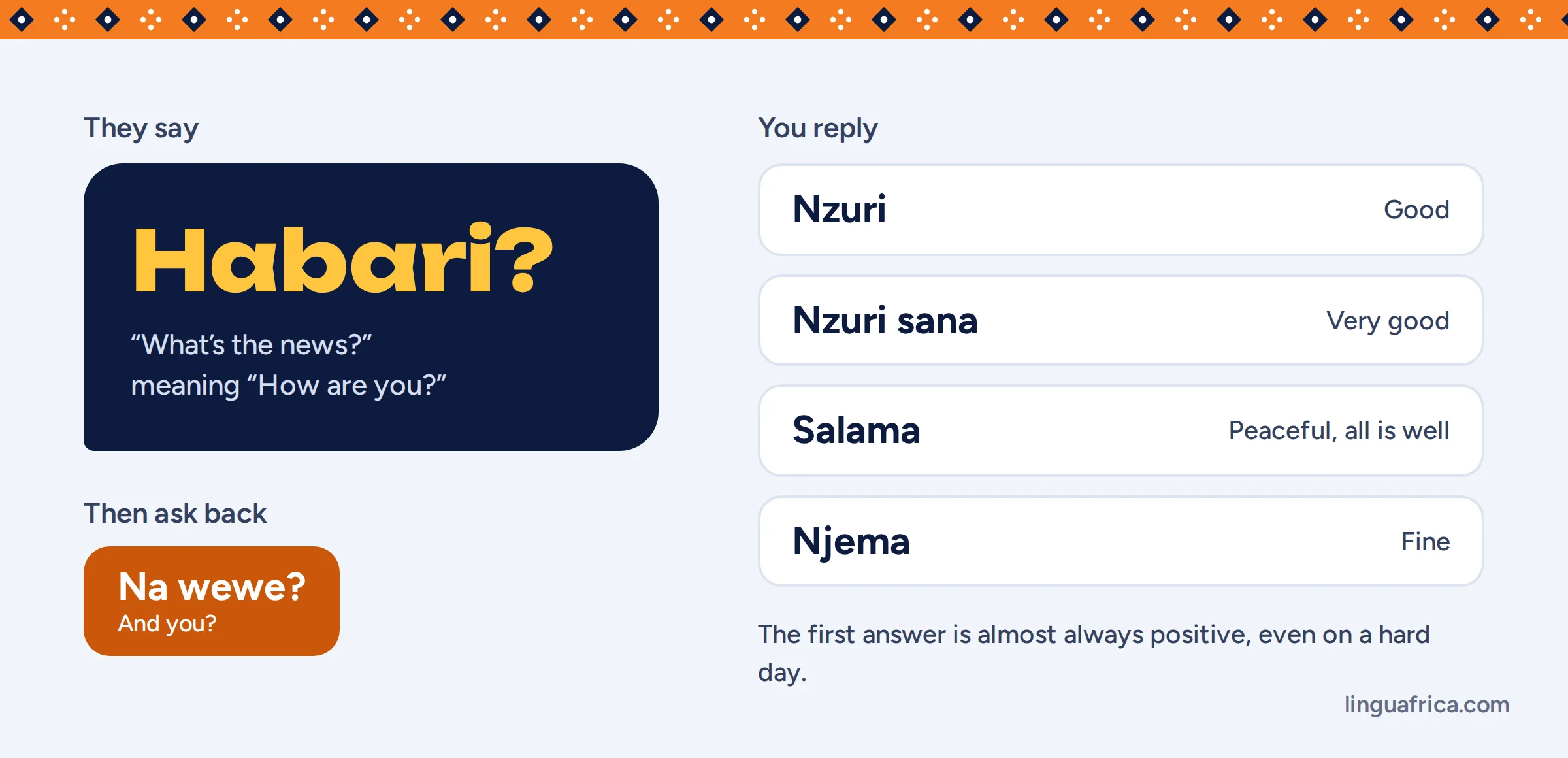
| They say | You reply | Meaning |
|---|---|---|
| Habari? | Nzuri. | How are you? Fine. |
| Habari yako? | Nzuri sana. | How are you? (your news) Very good. |
| Habari gani? | Salama. | What news? Peaceful, all is well. |
| Habari za leo? | Njema. | How is today going? Fine. |
Then turn it around. Ask them back with Na wewe? (“And you?”) or Habari yako? In Swahili, the person who answers usually asks the question back. A greeting is a small exchange, not a one-way street.
Here’s a lovely cultural detail: the answer is almost always positive. Even when someone is tired or having a hard day, they’ll usually say Nzuri first, and only then share their news: Nzuri, lakini nimechoka kidogo, “Fine, but I’m a little tired.” It’s a way of keeping the greeting gentle and kind.
Asking about home and work
Once you’re comfortable, you can add za (“of”) and ask about anything:
- Habari za nyumbani? How’s everyone at home?
- Habari za kazi? How’s work?
- Habari za safari? How was your journey?
The answer to all of them? Nzuri, of course.
Habari or Hujambo: which should you use?
Both are correct, and you’ll hear both. Habari is the everyday, all-purpose greeting: it works with friends, shopkeepers, colleagues and strangers. Hujambo is a little more traditional and is often used with children or in more formal moments. Another polite option is U hali gani? (“How are you?”), answered with Njema or Nzuri.
If you’re not sure, choose Habari. It’s always safe, always friendly, and always answered with Nzuri.
Good morning, afternoon and evening in Swahili
Swahili builds its time-of-day greetings on the same word. Just add the time:
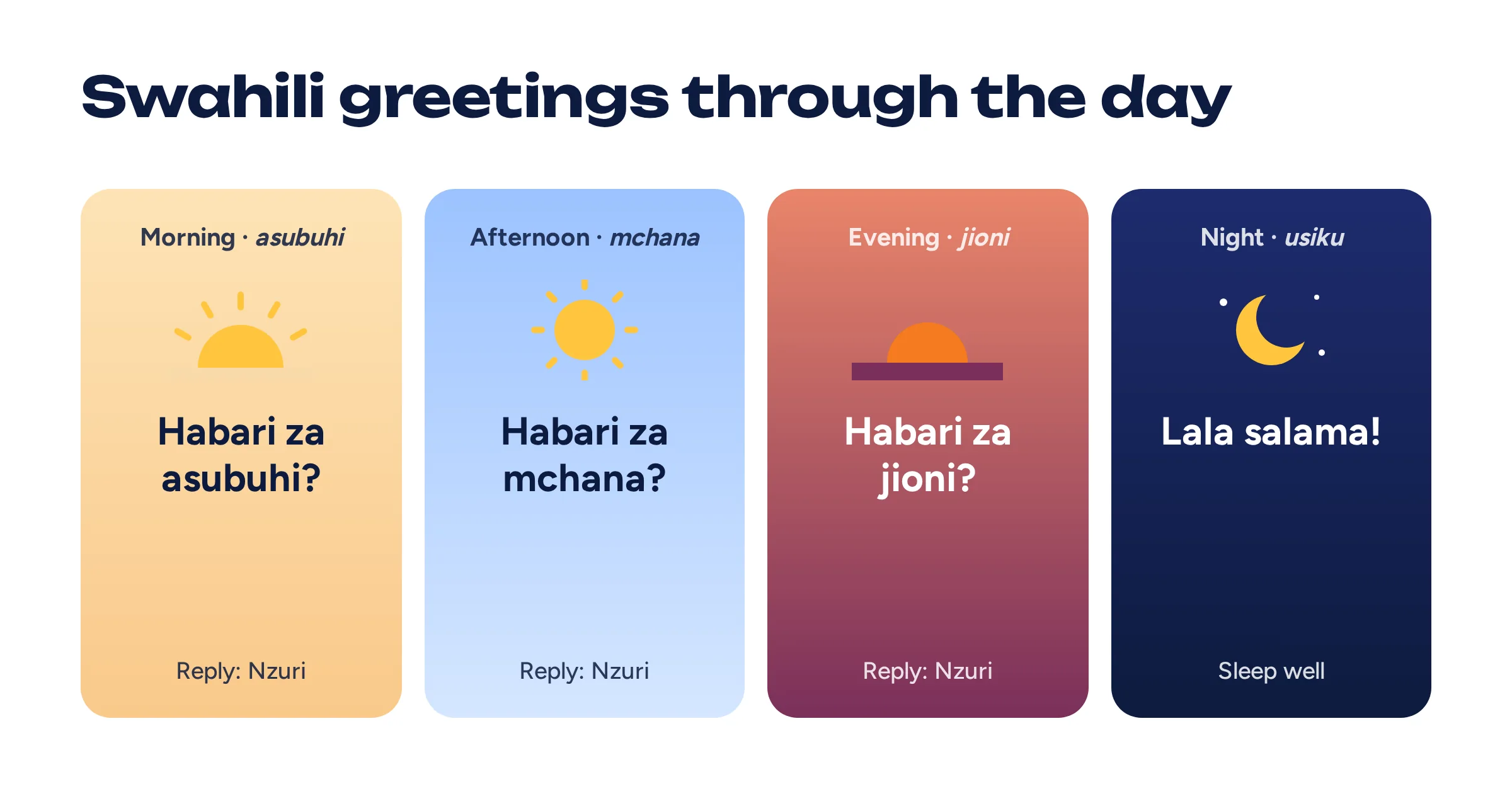
| When | Greeting | Reply |
|---|---|---|
| Morning | Habari za asubuhi? | Nzuri. |
| Afternoon | Habari za mchana? | Nzuri. |
| Evening | Habari za jioni? | Nzuri. |
| Night (going to bed) | Usiku mwema / Lala salama | Asante, na wewe pia. |
So how do you say good morning in Swahili? The most common way is Habari za asubuhi?, literally “News of the morning?”. In Tanzania you’ll also hear Umeamkaje?, a beautiful question that means “How did you wake up?”. The usual answer is Salama, “peacefully”.
At night, Usiku mwema means “good night”, and Lala salama means “sleep well” (literally “sleep in peace”). Both are perfect for a bedtime routine with children.
Mambo, Vipi, Sasa: casual Swahili greetings
Now for the greetings you’ll hear on the street, at school gates and in WhatsApp chats. These are relaxed and friendly, perfect with friends and people your own age, but not with elders.
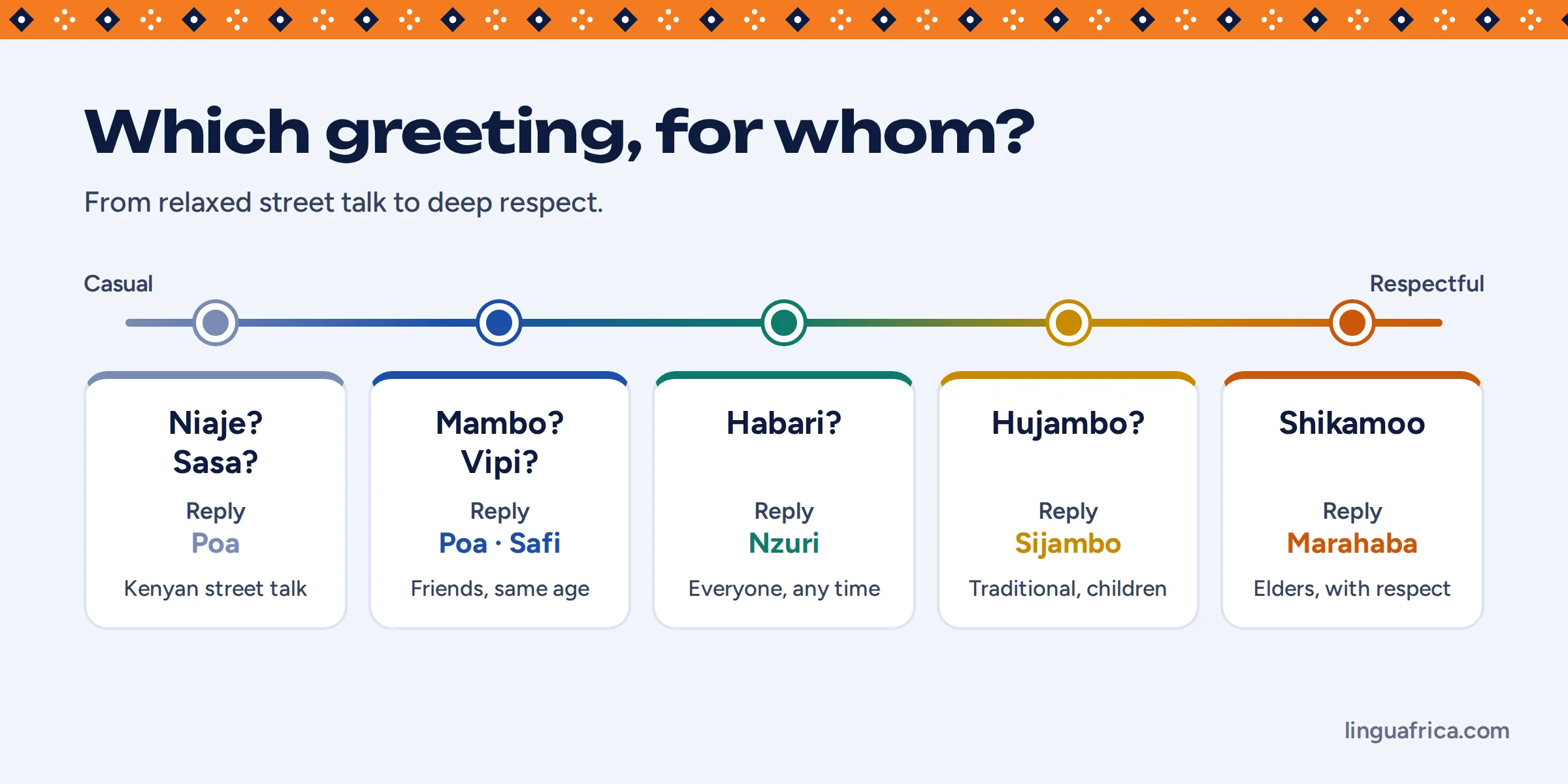
- Mambo? literally means “Things?”, as in “How are things?”. Reply Poa (“cool”) or Safi (“clean”, meaning “all good”). You’ll hear it everywhere in Tanzania.
- Vipi? means “How?”, a quick “What’s up?”. Reply Poa, Safi or Freshi.
- Sasa? literally means “Now?” and is very common in Kenya. Reply Poa.
- Niaje? is Kenyan street slang (from Sheng, the mix of Swahili and English spoken by young Kenyans). Reply Poa.
Want to sound natural? Add sana (“very”) or kabisa (“totally”): Poa sana! Safi kabisa!
You’ll often hear these stacked together, too. A friend might call out Mambo vipi? (“How are things, what’s up?”) as they walk over, and the easiest answer in the world is a big smile and Poa! If you want to keep the chat going, add Na wewe je? (“And you?”).
One gentle warning: young people’s slang changes fast and varies between cities. The safest approach is to listen to how people around you answer and copy them. Nobody will mind if you just say Poa.
What about Jambo?
If you’ve ever been on safari, you’ve probably heard Jambo! It’s friendly and everyone understands it, but it’s mostly used with tourists. Swahili speakers usually say the full form, Hujambo? (“Are you well?”, literally “You have no problems?”). The reply is Sijambo (“I’m well”, literally “I have no problems”). To a group, ask Hamjambo?, and the group answers Hatujambo.
So Jambo won’t get you into trouble, but Habari or Hujambo will make you sound like someone who’s really learning.
Kenya or Tanzania? Small differences
Swahili is one language, but you’ll notice a few local flavours. In Tanzania, greetings tend to be longer and more formal, and Shikamoo (more on that below) is used all the time. In Kenya, people often switch more quickly to casual greetings like Sasa? or Niaje?, and many conversations mix Swahili and English. Along the coast, from Mombasa to Zanzibar, you’ll hear Swahili at its most traditional, as it has been spoken there for centuries.
None of this should worry you as a learner. Habari, Nzuri, Asante and Karibu work everywhere, from Dar es Salaam to Nairobi to Kampala.
Shikamoo: how to greet elders with respect
This is the greeting that wins hearts. Shikamoo (shee-kah-MOH) is how younger people greet their elders, especially in Tanzania. It’s usually explained as coming from words meaning “I hold your feet”, a deep expression of respect.
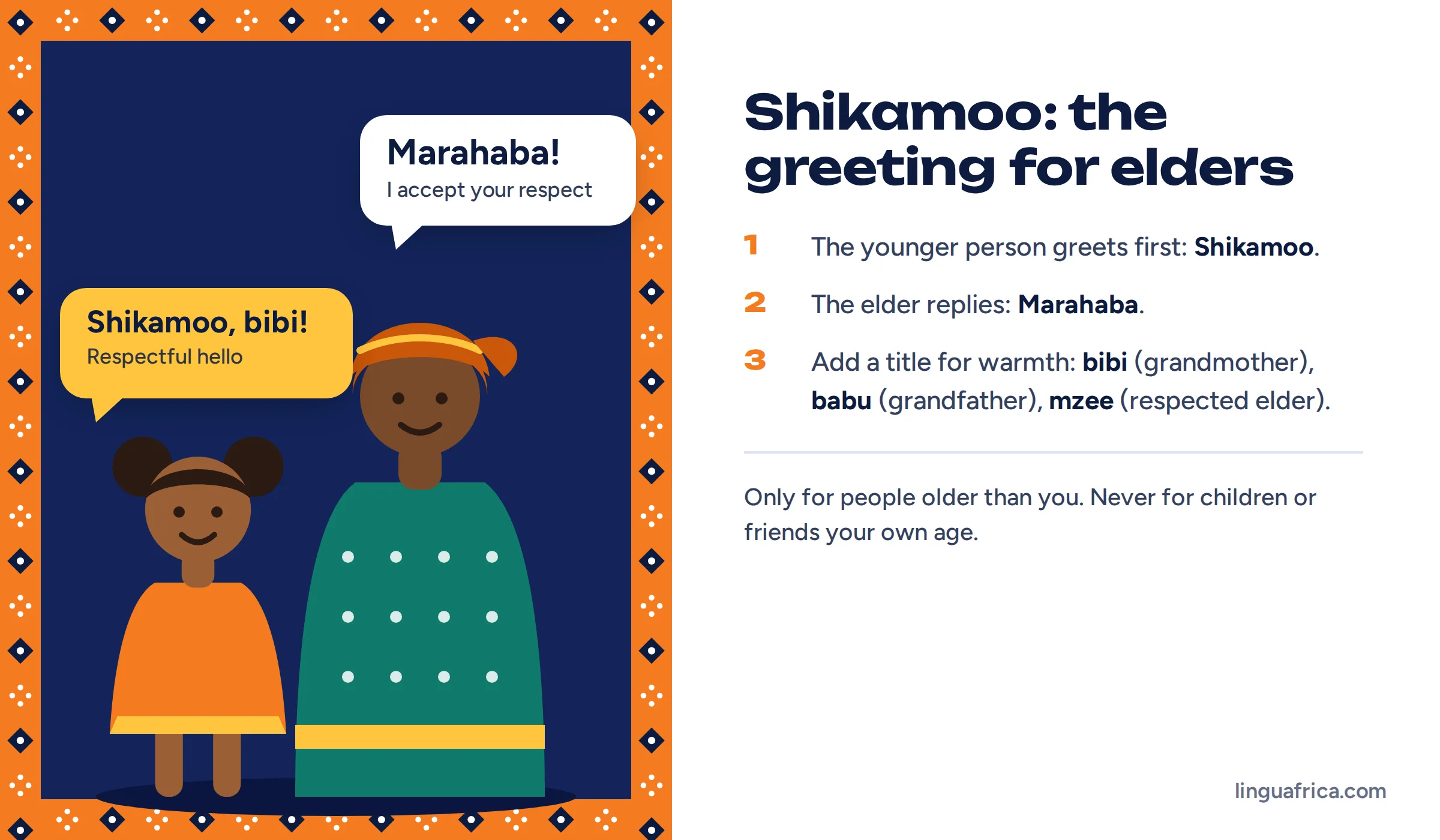
The elder replies Marahaba (mah-rah-HAH-bah), which means something like “I accept your respect” or “I’m delighted”. That’s it: two words, and you’ve shown the respect that matters so much in Swahili culture.
A few things to know:
- Use it with anyone clearly older than you: grandparents, aunties and uncles, teachers, the older lady at the market.
- Never use it with someone younger than you or the same age. It would sound odd, even a little mocking.
- Add a title to make it even warmer: Shikamoo, bibi (grandmother), Shikamoo, babu (grandfather), Shikamoo, mama or Shikamoo, mzee (to a respected older man).
- Body language helps. When shaking hands with an elder, many people bow slightly and touch their right elbow or forearm with their left hand.
If you’re raising children in the diaspora, Shikamoo is one of the best words you can teach them. The look on a grandparent’s face when a small child says “Shikamoo, bibi!” on a video call is worth every minute of practice.
Thank you, welcome and goodbye in Swahili
A greeting opens the door. These words keep the conversation warm and close it kindly.
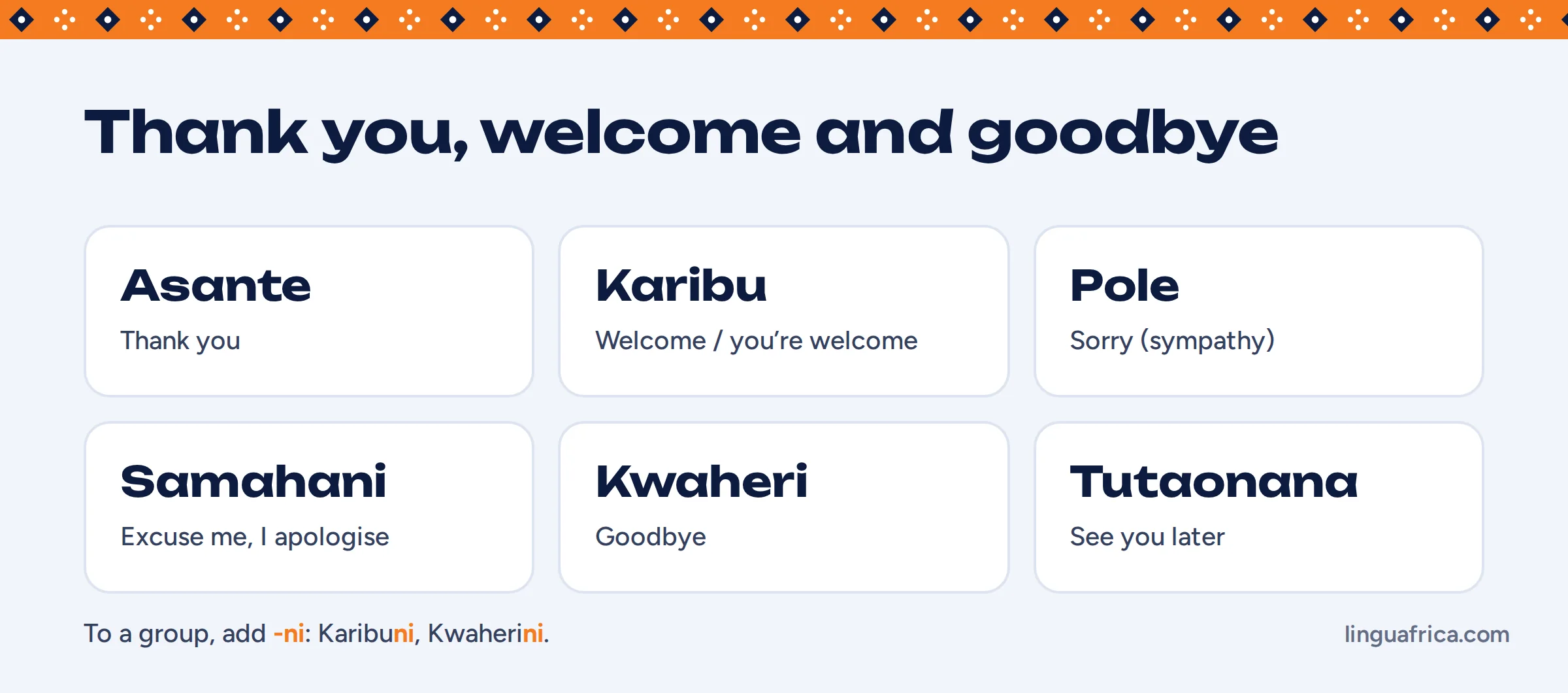
- Asante means “thank you”. Asante sana means “thank you very much”.
- Karibu means “welcome”, and you’ll hear it everywhere: at the door, in shops, when food is served. It’s also the reply to Asante, a bit like “you’re welcome”. To a group, say Karibuni.
- Pole means “sorry”, but it’s used with sympathy rather than apology: if someone is tired, ill or has had a long journey, say pole or pole sana. Pole na kazi is said to someone working hard. The reply is Asante.
- Samahani means “excuse me” or “I’m sorry” when you need to apologise or get someone’s attention. Use samahani if you bump into someone, and pole when someone else is having a hard time.
- Tafadhali means “please”. It’s polite, though in everyday speech a warm tone and a greeting often do the same job.
- Kwaheri means “goodbye”. To a group, say Kwaherini.
- Tutaonana means “we’ll see each other”, like “see you later”.
Put it all together: a full Swahili greeting
Here’s how a real, everyday exchange might sound between two friends meeting in the afternoon:
| Person | Swahili | English |
|---|---|---|
| Amina | Habari za mchana? | Good afternoon! |
| Juma | Nzuri sana. Na wewe? | Very good. And you? |
| Amina | Nzuri. Habari za nyumbani? | Fine. How’s everyone at home? |
| Juma | Wote wazima, asante. | Everyone’s well, thanks. |
| Amina | Haya, tutaonana! | OK, see you later! |
| Juma | Kwaheri! | Goodbye! |
Read it out loud a few times. Then try it with a friend, a family member, or even your reflection. Every time you say it, it becomes a little more yours.
Common mistakes with Swahili greetings
- Skipping the greeting. Asking for directions or a price without greeting first can feel abrupt. Start with Habari or Shikamoo, then ask.
- Answering “bad”. Even on a rough day, the first answer is Nzuri. Share the details afterwards if you want to.
- Using Mambo with elders. Mambo and Vipi are for friends. With older people, use Shikamoo or Habari za asubuhi.
- Forgetting to ask back. A greeting is two-way. After you answer, ask Na wewe?
- Saying Shikamoo to children. It’s only for people older than you. Children say it to adults, never the other way round.
Swahili greetings for children
Children learn greetings fastest when they’re part of daily life. Try a simple family routine: say Habari za asubuhi? at breakfast and help your child answer Nzuri! Teach them Shikamoo for grandparents and Asante at every meal. At bedtime, finish with Lala salama. In a few weeks, these words won’t feel like lessons any more. They’ll simply be how your family talks.
How to practise Swahili greetings every day
- Greet your family in Swahili every morning. Habari za asubuhi? takes three seconds.
- Answer your phone in Swahili. Habari? is a fun way to surprise Swahili-speaking relatives.
- Teach your children Shikamoo and Asante. Short, useful words give kids quick wins.
- Listen to Swahili music and radio. Greetings come up constantly, and you’ll start to hear the rhythm.
- Practise with short daily lessons. The Linguafrica app teaches Swahili with audio, visuals, storytelling and cultural notes, with streaks to keep you going.
If you’re curious how greetings work in other African languages, see how Yoruba speakers greet through the day in our guide to learning Yoruba, or discover the Zulu greeting that means “I see you” in Learn Zulu: Sawubona.
Frequently asked questions
What is the most common Swahili greeting?
The most common greeting is Habari?, which means “What’s the news?” and is used like “How are you?”. Reply with Nzuri (“fine”) or Nzuri sana (“very good”). With friends, you’ll also hear Mambo? and Vipi?, answered with Poa.
How do you reply to Habari in Swahili?
Say Nzuri (“good”), Nzuri sana (“very good”), Salama (“peaceful”) or Njema (“fine”). Then ask back with Na wewe? (“And you?”).
How do you say good morning in Swahili?
Say Habari za asubuhi?, literally “News of the morning?”. The reply is Nzuri. In Tanzania you’ll also hear Umeamkaje? (“How did you wake up?”), answered with Salama.
What does Shikamoo mean in Swahili?
Shikamoo is a respectful greeting that younger people use with elders. It’s usually explained as meaning “I hold your feet”. The elder replies Marahaba, meaning “I accept your respect”.
Is Jambo a real Swahili greeting?
Yes, but it’s mostly used with tourists. Swahili speakers usually say Hujambo? (“Are you well?”), answered with Sijambo (“I’m well”), or simply Habari?
How do you say hello to a group in Swahili?
To a group, ask Hamjambo? and the group answers Hatujambo (“we’re well”). You can also say Habari zenu? (“How are you all?”), answered with Nzuri. Among friends, Mambo vipi? works well too.
What does Karibu mean?
Karibu means “welcome”. It’s used when someone arrives, when food is served and as the reply to Asante (“thank you”). To more than one person, say Karibuni. You’ll often hear Karibu sana, “you’re very welcome”.
How do you say thank you in Swahili?
Say Asante, or Asante sana for “thank you very much”. The usual reply is Karibu, which means “you’re welcome”.
Karibu: you’re welcome here
Swahili greetings are a gift. They slow a moment down, make room for another person, and turn a quick hello into a real connection. Whether you’re visiting family in Mombasa, travelling through Tanzania, or helping your children talk to their grandparents on a video call, these few words open doors that no translation app can. Start with Habari, keep Shikamoo ready for the elders in your life, and don’t worry about getting everything perfect. A warm greeting with a few mistakes is always better than silence.
When you’re ready for the next step, explore all the languages we teach, listen to our podcast, or read why we started Linguafrica. And when you’re ready to go beyond greetings, our beginner’s guide to learning Swahili is the perfect next read.